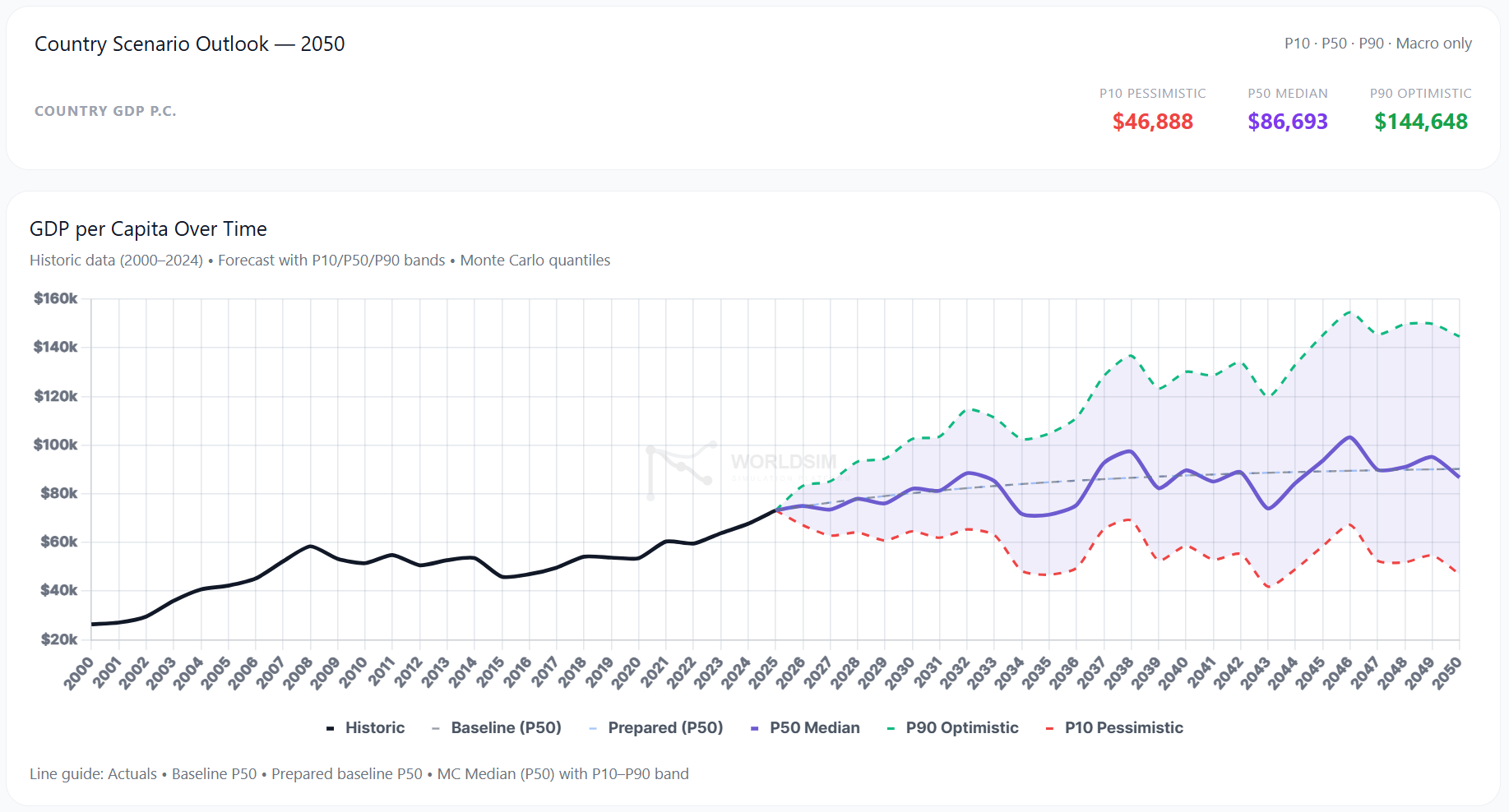
Stop Predicting. Start Exploring.
Most economists predict a number. The world is a distribution. Every long-horizon forecast is one path through a wider distribution. The variance is the signal.
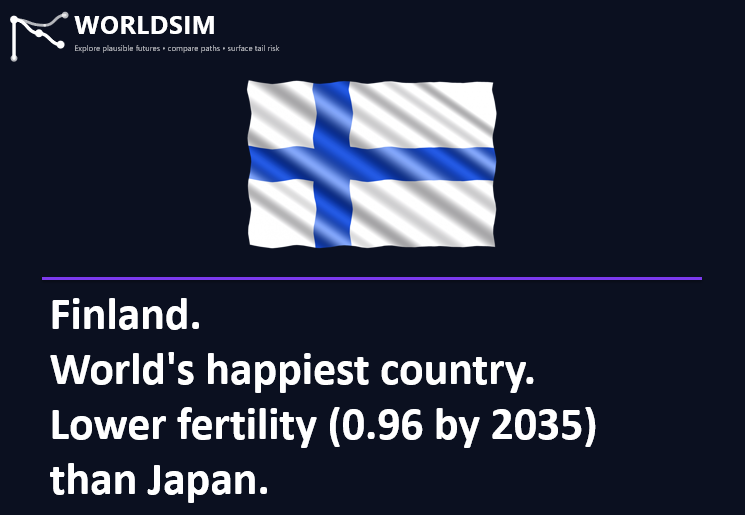
0.96: Finland's Fertility Number Lands Lower Than Japan by 2035
The world's happiest country has had sub-replacement fertility for 45 consecutive years. The 2035 baseline says it keeps falling. No obvious lever to pull.
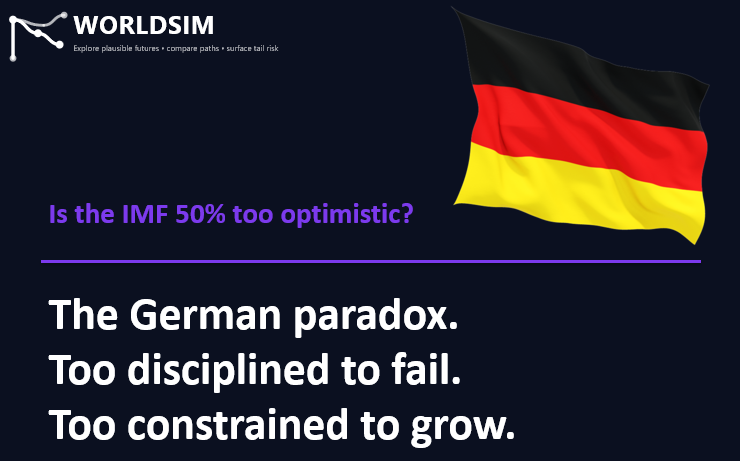
Is the IMF 50% Too Optimistic? The German Paradox in 2035
Germany is doing almost everything right and still growing at half the rate consensus projects. 5,000 Monte Carlo paths land at +7% GDP per capita over the decade.
Beyond the Point Forecast: A 6-Layer Simulation Engine for 195 Countries
A flight simulator for economic policy. Probabilistic, reproducible, EU-built. 30+ indicators, 100+ coupling rules, 10,000 trajectories per scenario.
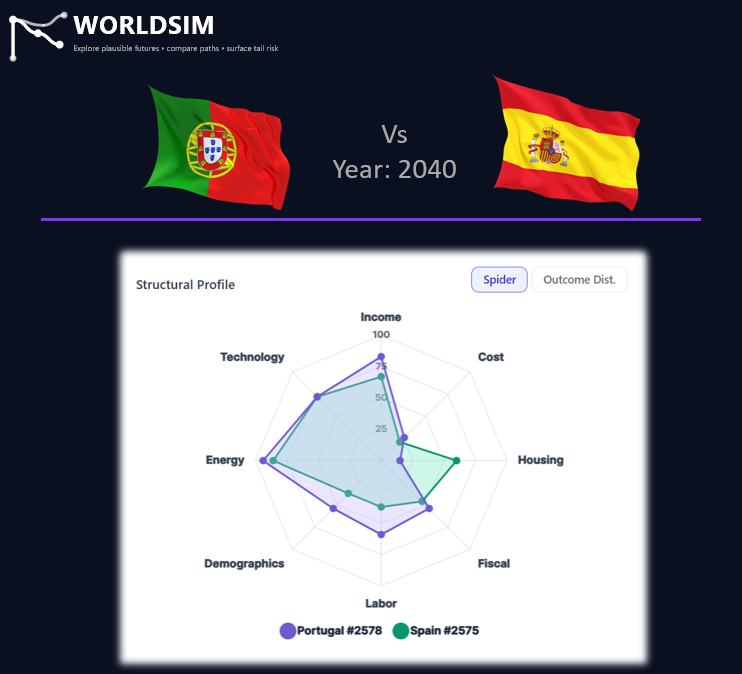
Iberian Convergence: Three Crossovers in a Decade
Portugal and Spain end 2040 on the same per-capita income, in the same regime, having paid for it with opposite structural crises. Fertility, housing, debt.
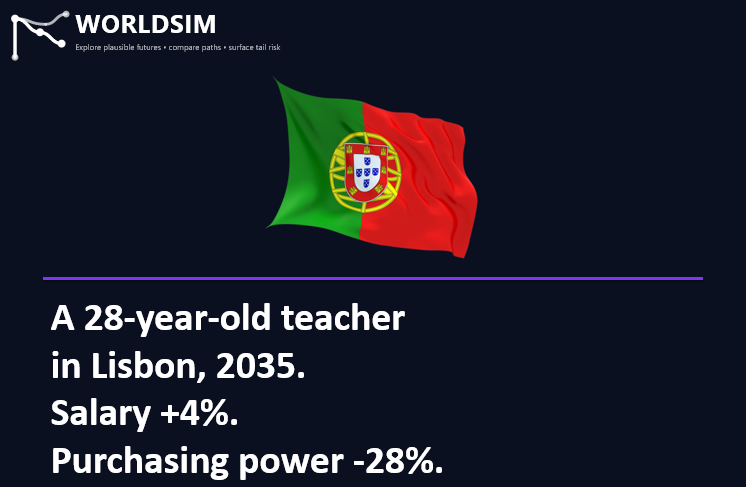
A Lisbon Teacher in 2035: When Annual Rent Exceeds Annual Salary
GDP grows 5% in a decade. Rents grow 37%. The teacher's annual rent reaches 117% of annual salary. A country statistic becomes a labour-market failure.

What Is Monte Carlo Simulation? And Why Does It Matter for Policy?
Roll a die once, you get a number. Roll it 10,000 times, you get a distribution. That distribution tells you more than any single forecast.
Spain: Running to Stand Still. 14 Positive Rules. 14 Negative.
Fertility drops below 1.0. Rent takes 48% of income. Unemployment drops 40%. Every tailwind offset by an equally powerful headwind. 8% growth in a decade.

Poland's GDP Grows 15%. The Engine Says: "Stagnating."
Fertility at 1.12. Net migration drops to zero. Population 65+ hits 26.7%. A demographic time bomb hiding inside the EU's best growth story.
France's GDP Drops 5.8% by 2035. And That's the Baseline.
Three structural traps fire at once: Tax Wedge at 45.2%, debt crossing 120% of GDP, and 26.8% aged 65+. 20 negative rules vs 13 positive.
You Are 28, in Germany, Working in Data & AI. What Does 2035 Look Like?
Your salary nearly doubles to $81,071. But inflation eats a third of the gains. A median house costs $585,161. Full personal projection inside.

Can Italy Survive $110/Barrel Oil for 4 Years?
Stress-testing the OECD's Hormuz scenario. 72% of simulated futures show structural stress. GDP per capita drops 4.7%, comparable to 2008.

Romania vs. Greece: The Convergence No One Is Talking About
Romania grows 52%. Greece contracts 17%. 10,000 Monte Carlo simulations show a GDP crossover is on the table. But Greece's P90 upside tells a different story.

Is the "Grecovery" One Oil Shock Away From a Total Stall?
The IMF says Greece is on track: debt to 110%, growth at 1.8%. We ran 2,000 Monte Carlo simulations through 2035. The P50 median for debt lands at 168%.