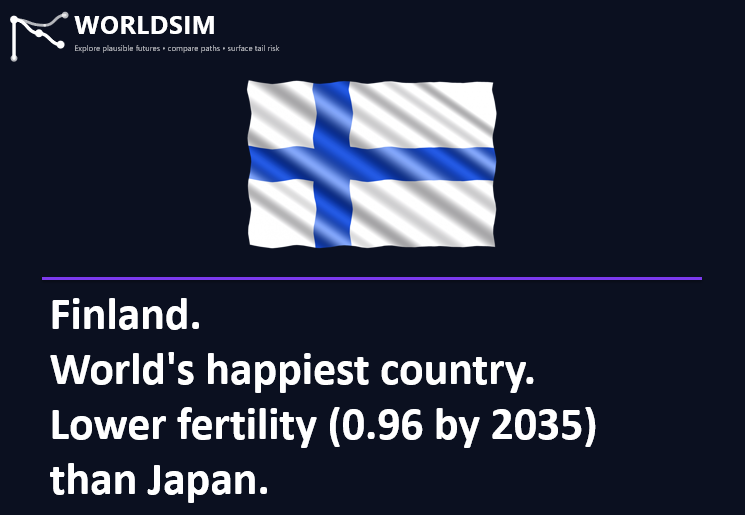
The world's happiest country has had sub-replacement fertility for 45 consecutive years. WorldSim's 2035 baseline says it keeps falling.
Finland is having a strange moment. It tops the World Happiness Report for the seventh year running. It just spent two years completing its NATO accession and closing its eastern border with Russia. Its electricity is among the cheapest in Western Europe. And its total fertility rate has been below replacement for 45 consecutive years, with no sign of bottoming.
Helsinki recorded a TFR of around 1.13 in 2023. The national average sits at 1.26. The trend line still points down. This is not a country in fiscal crisis or a country in geopolitical retreat. It is a country running a long, quiet experiment on what happens when the most generous family policy in modern history produces fewer babies every year.
Running Finland through WorldSim to 2035 (5,000 Monte Carlo trajectories, average path, no extreme tilts, 26 KPIs connected by 100+ coupling rules):
Finland is not breaking. It has structural strengths that most peers would envy: cheap electricity, a deeply funded welfare state, low cost of living relative to income, energy resilience, and the world's strongest happiness signal. None of that pulls fertility back above 1.
The triggers that fire across the simulation are not new. They are the slow demographic compounding that started in the 1980s and never reversed. The structural drag is built in. Coupling rules around ageing pressure, fiscal tightening, and labour-supply contraction fire across the simulation as the working-age share thins out.
Finland has tried almost everything that gets recommended in fertility-policy literature. Generous parental leave, free childcare, gender equity in the labour market, cash transfers, baby boxes, fully funded education. Fertility kept falling.
The model can tilt fertility back up in the simulation. Reality has no such slider. A generation of women having 0.96 children each is not a tilt you can manage around. It is a regime shift, operating on a slower clock than any policy lever can reach in a 10-year window.
The complete piece walks through Finland's structural strengths, the coupling rules that fire across the simulation, and what the data says about whether the trend can reverse.
Read on Substack →Tilt fertility, ageing, and migration sliders. See how the cascade reshapes 2035 across all 26 KPIs.
Try WorldSim →