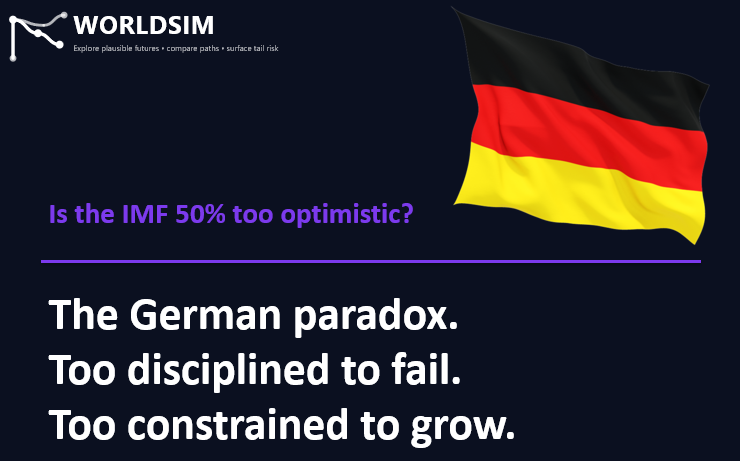
5,000 Monte Carlo paths, 100+ structural coupling rules, and a country that does almost everything right and still grows at half of consensus.
Germany dominates EU macro discourse in 2026. The debt brake debate, ReArm Europe, the industrial decline narrative, the defence spending ramp announced post-Bundestag are all framed as urgent crises. The political and media consensus reads: Germany is breaking.
The data tells a more nuanced story. Germany is not breaking. It is doing almost everything right and still growing at roughly half the rate consensus projects. That is a different problem, and a more durable one.
Running Germany through WorldSim to 2035 (5,000 Monte Carlo trajectories, average path, no extreme tilts):
Compare that to consensus projections of 1.2 to 1.5% annual real GDP growth for the same horizon, which works out to 12 to 16% cumulative. WorldSim's median lands at half that.
Germany is not in crisis. It is the EU's most fiscally disciplined economy. It has a strong industrial base, deep capital markets, low debt, and a credible central bank. It is also a country whose growth ceiling is roughly half of what most institutional forecasts project.
The reasons are structural. Demographics constrain the working-age population. Energy transition costs are loaded into the next decade. Industrial competitiveness has eroded against the United States and China without a clear catch-up path. None of those reverse on a 10-year clock with the policies currently announced.
If consensus is 50% too optimistic on Germany's growth ceiling, the implications cascade across the EU. ReArm budgets become harder to fund. Pan-European productivity converges down rather than up. The fiscal headroom that Germany was supposed to provide in a future European downturn is thinner than the official numbers suggest.
This is not a crisis story. It is a slow-grinding-down-to-half-of-projected-growth story. Different problem, different policy response.
The complete piece walks through which coupling rules fire, the oil-shock stress test, the inflation cone, and why this is a structural ceiling rather than a cyclical drag.
Read on Substack →Tilt the inputs, switch between Better, Average, and Shock paths, and see how 26 KPIs reshape over the simulation horizon.
Try WorldSim →