Use Case: Hedge Funds & Macro Investors

Country Risk & Tail Risk Quantification

Macro funds, sovereign wealth funds, and institutional investors need to quantify country-level structural risk, not as an ordinal rating, but as a probability distribution with explicit tail scenarios.

WorldSim lets you run your own trade thesis as a scenario configuration, testing rate paths, inflation regimes, sovereign stress, and energy shocks across 195 countries with full distributional outputs.

The Status Quo

How Macro Investors Assess Country Risk Today

Current tools give you a rating or a point forecast. The market delivers a distribution.

Oxford Economics / Capital Economics

Pre-packaged scenario subscriptions with fixed scenario sets. You get their scenarios, not yours. Can't test your specific trade thesis as a configuration.

Credit Ratings (Moody's, S&P, Fitch)

Ordinal ratings (AAA to D) with no distributional information. You know Italy is BBB, but what's the probability it reaches BB under a stagflation scenario? Ratings can't answer that.

Bloomberg / Reuters Terminal

Backward-looking data and market prices. Excellent for what happened, but no structural forward-looking scenario engine. You can see the spread, but not model what drives it.

Internal Quant Models

Expensive to build and maintain, narrow in scope (typically 3-5 macro variables), and rarely model cross-domain structural coupling. Most funds don't have them for country risk.

The WorldSim Approach

Your Trade Thesis as a Scenario Configuration

WorldSim turns macro trade ideas into quantified distributional outcomes, in minutes, not weeks.

Tail Risk Quantification

Every output is a distribution (P10/P50/P90). You don't just see "debt rises"; you see the probability that Italian debt exceeds 190% GDP. The P90 tail is where the trade lives.

Cross-Domain Structural Coupling

When you tilt rates and inflation, WorldSim automatically cascades the effects to debt service, fiscal stress, employment, migration, and housing: the structural feedback loops that drive sovereign spreads.

Custom Scenario Configurations

Run your exact thesis: "ECB holds at 4% while Italian inflation stays sticky at 5%+." Tilt any combination of the 26 KPIs with configurable persistence and decay. No waiting for a vendor's quarterly update.

Cross-Country Comparison

Compare any two scenarios side by side: stressed Italy vs baseline Italy, or Italy vs Spain under identical conditions. The structural profile spider chart and bucket scores quantify the relative risk instantly.

KPIs Most Relevant to Macro Investors

GDP per capita Growth trajectory
Public debt (% GDP) Sovereign risk
Inflation rate Monetary regime
Interest rate (policy) Rate path
Unemployment rate Labour stress
Gov. expenditure (% GDP) Fiscal trajectory
Net migration rate Structural flows
Petrol price (USD/litre) Energy exposure
Trade Thesis Testing

Questions WorldSim Answers for Macro Investors

Each question is a scenario you can run, producing the distributional output your risk models need.

SOVEREIGN RISK

If ECB holds at 4%+ while Italian inflation stays above 5%, does the sovereign debt trajectory become unsustainable?

The BTP-Bund spread question quantified. WorldSim models the debt-service cost spiral, fiscal squeeze, and the probability of debt exceeding 190% GDP under sustained stagflation.

RATE PATH

What's the structural impact of ECB cutting to 1% vs holding at 4% across Southern vs Northern Europe?

Run the same rate scenario on Italy, Spain, Greece, and Germany simultaneously. Compare the distributional outcomes for housing, fiscal, and growth: the structural divergence that drives relative value trades.

INFLATION REGIME

What's the probability distribution of Eurozone inflation under a supply-shock scenario with $150 oil?

The energy-inflation pass-through quantified with P10/P50/P90 bands. WorldSim's coupling rules model the cascade from petrol to CPI to rates to housing: the full transmission chain.

DEMOGRAPHIC RISK

How does Southern Europe's demographic decline interact with fiscal sustainability over 15 years?

Italy's 65+ share is heading to 29%+. WorldSim models the pension cost spiral, tax base erosion, and immigration dependency: the slow-moving structural risk that sovereign CDS doesn't price until it's too late.

TAIL RISK

What does the P90 worst case look like for Greek debt under a combined rate + energy + fiscal shock?

The tail scenario that stress-test desks need. WorldSim produces the full distribution, including the 10th percentile outcome where multiple structural pressures compound simultaneously.

RELATIVE VALUE

Under identical shock conditions, which EU country shows the most structural resilience?

Use WorldSim's Comparison Engine to run the same scenario across multiple countries. The Trajectory Index and structural bucket scores give you a quantified ranking, not a subjective analyst opinion.

Real-World Context

The Macro Trades That Define This Cycle

Every major macro trade of the past three years has been a structural scenario question that WorldSim can model.

ITALY SOVEREIGN STRESS 2022

The BTP-Bund Spread Blow-Out

When Draghi resigned in July 2022, the BTP-Bund spread spiked 50bps in days. The market was pricing a structural question: can Italy service 145% debt/GDP with ECB rates at 4%? WorldSim models exactly this scenario: the interaction between rate path, debt dynamics, and fiscal space.

ECB RATE CYCLE 2022-2025

The Fastest Tightening in ECB History

ECB moved from 0% to 4.5% in 14 months. The structural question every macro fund asked: "What breaks first: Southern European housing, corporate credit, or sovereign debt?" WorldSim's coupling rules model all three channels simultaneously with full distributional output.

UK GILT CRISIS SEPT 2022

When Fiscal Policy Broke the Bond Market

The Truss mini-budget triggered a gilt market crash and pension fund margin calls. The structural lesson: fiscal expansion under inflationary conditions can produce non-linear sovereign stress. WorldSim's BSE (Black Swan Engine) rules model exactly these threshold effects.

TURKEY / ARGENTINA INFLATION

Inflation De-anchoring in Real Time

Turkey: 15% → 85% → 65%. Argentina: 25% → 290%. Once inflation de-anchors, the spiral is self-reinforcing. WorldSim's BSE-07 (Inflation Spiral) rule fires when inflation exceeds 10% for 2+ years, triggering the compound deterioration that macro funds need to model for EM positions.

Scenario Walkthrough

Italy: Stagflation + Sovereign Stress to 2040

The core macro question: if ECB rates stay elevated while Italian inflation remains sticky and debt keeps climbing, what's the structural trajectory? We ran this exact scenario.

Scenario Configuration

Country
Italy
Scenario Path
As Planned
Simulations
5,000 trajectories
Horizon
2040
Applied Tilts (5-year persistence)
Interest rate +8σ (2.2% → 5.4%) Inflation +5σ (1.1% → 2.2% median, P90 peaks ~15%) Public debt +3σ
1

Structural Overview: TI 0.43, 42% of Paths Hit Structural Stress

Italy's Trajectory Index drops to 0.43 under this scenario. Only 6% of simulated paths show improvement. The domain scores tell the story: Income falls to 0.39 (GDP per capita declines 10.9% from $43,161 to $38,468), Fiscal to 0.37 (debt reaches 166.7% of GDP), Cost of Living to 0.29 (inflation nearly doubles), and Demographics to 0.17 (ageing accelerates, fertility drops to 1.02, net migration falls 29%). Housing (0.66), Technology (0.73), and Energy (0.83) remain resilient; this is a fiscal-demographic crisis, not a broad collapse.
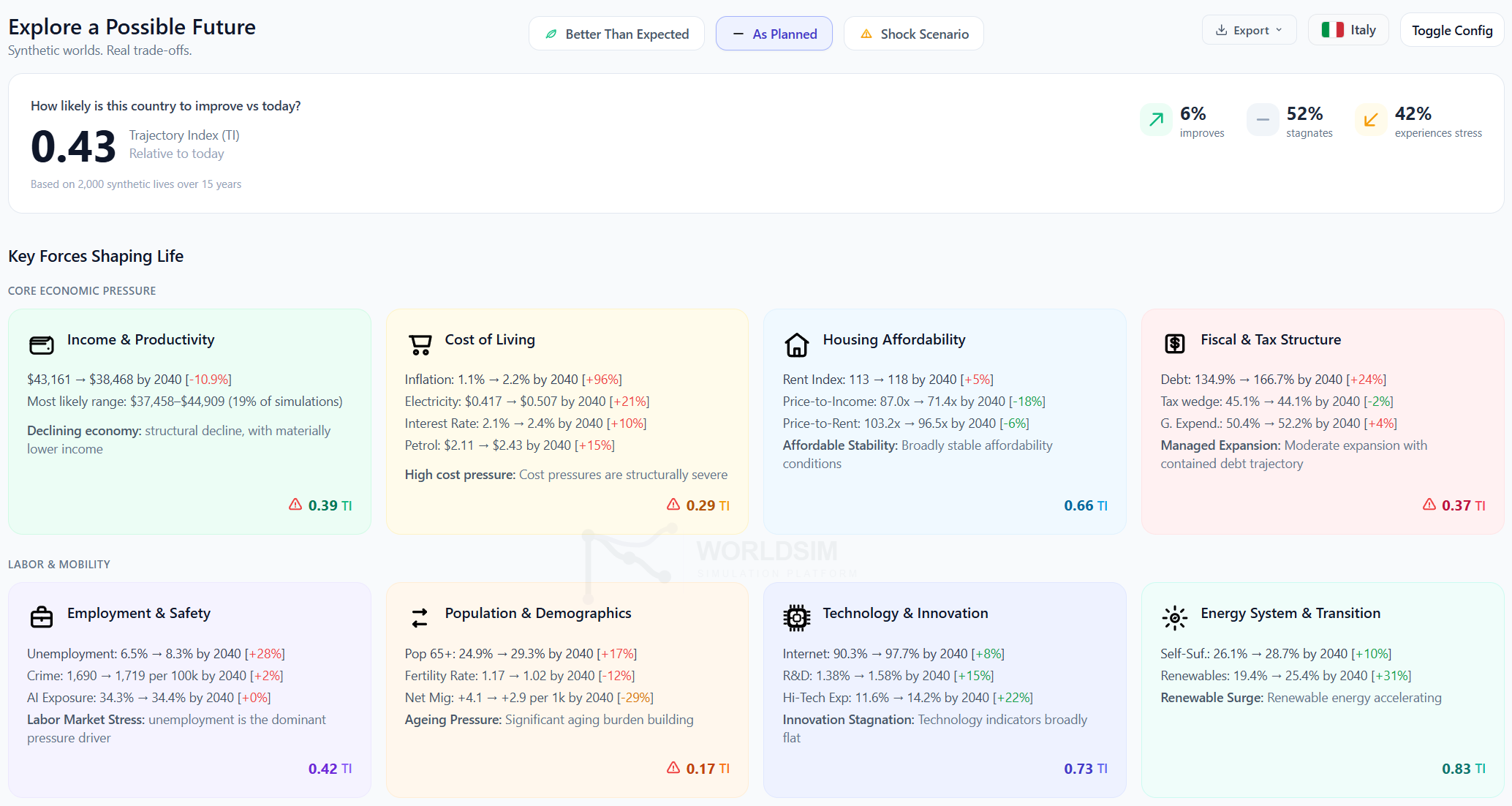
worldsimlab.com/explore — Italy, As Planned, 5,000 simulations to 2040
WorldSim Italy Stagflation Scenario — TI 0.43, 9 domain scorecards
2

The Sovereign Debt Trajectory: 134% → 167% GDP, P90 Hits 194%

This is the number macro funds care about most. Italian public debt rises from 134% to 166.7% of GDP at the P50 median. But the tail tells the real story: the P90 pessimistic scenario shows debt reaching 194.3% of GDP, the level that triggers restructuring conversations. Government expenditure rises to 52.2% of GDP (P90: 58.3%) while revenue barely keeps pace at 47.1%. The fiscal squeeze is structural, not cyclical.
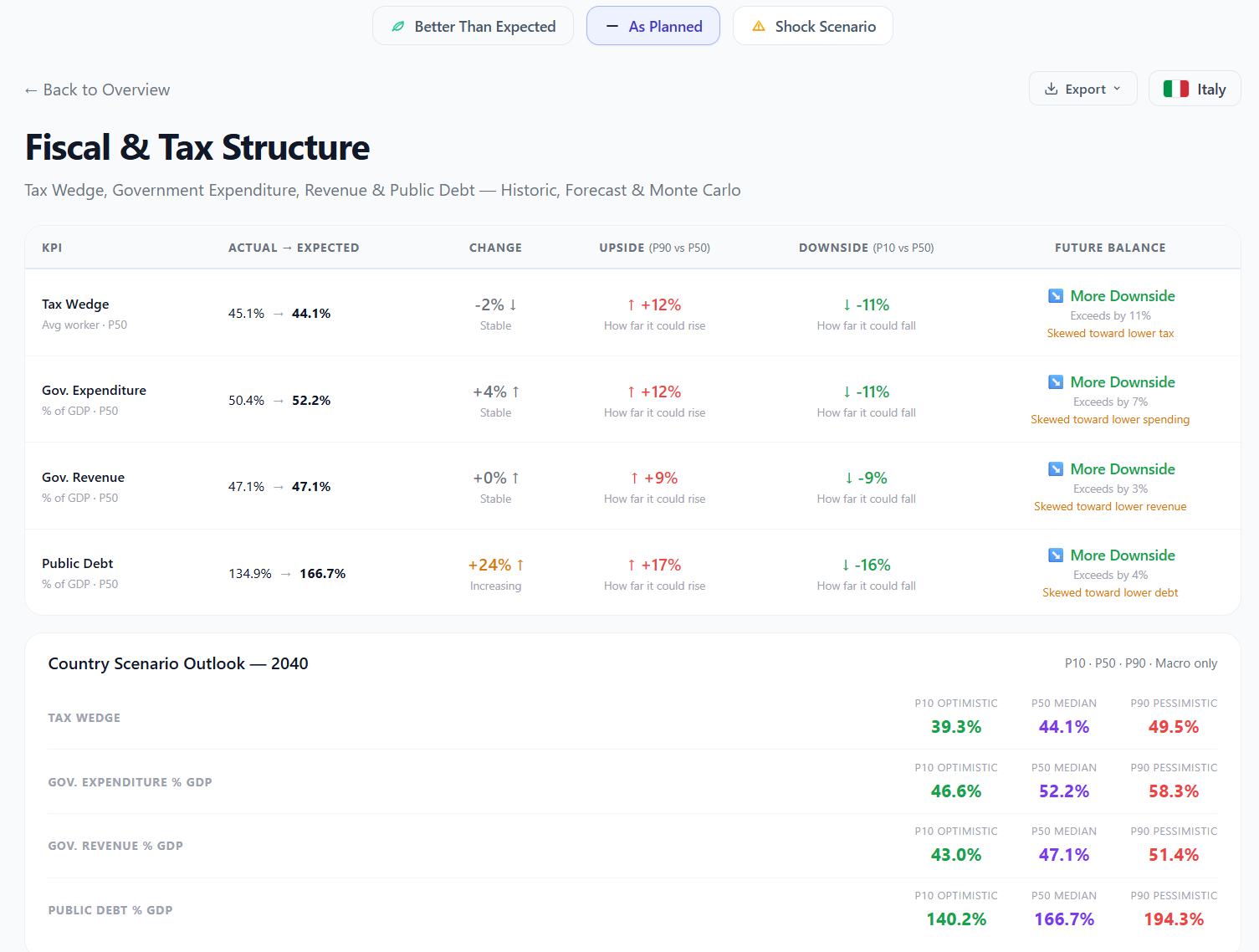
worldsimlab.com/drilldown/fiscal-tax — Debt, Expenditure, Revenue with P10/P50/P90
WorldSim Italy Fiscal Drilldown — Public debt 134% to 167%, P90 at 194%
3

The Inflation Story: P90 Spikes to ~15% Before Reverting

The inflation fan chart shows the acute phase: the P90 pessimistic path spikes toward 15% around 2027 before the coupling rules pull it back. The P50 median settles around 8-10% during the stress period, eventually reverting to ~2-3% by 2040. The 2040 distribution histogram shows the fat tail clearly: most outcomes cluster around 3-4%, but a meaningful fraction remains above 5%. This is the inflation regime risk that drives the rate path trade.
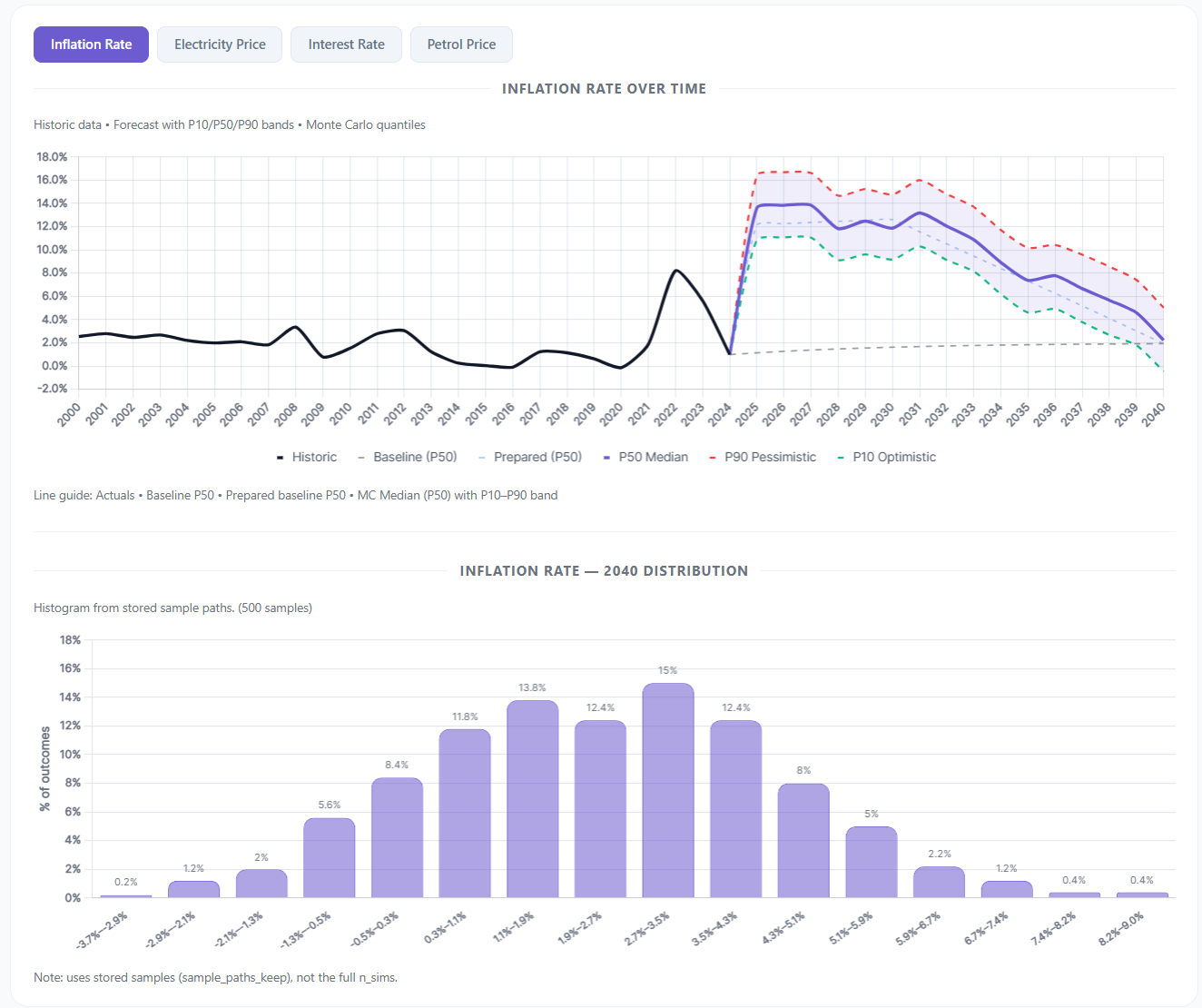
worldsimlab.com/drilldown/cost-of-living — Inflation fan chart + 2040 distribution
WorldSim Italy Inflation — P90 spikes to ~15%, fat-tailed 2040 distribution
4

The Structural Cascade: BSE-03 Sovereign Debt Crisis Fires in Year 1

WorldSim's Black Swan Engine triggers BSE-03 (Sovereign Debt Crisis) immediately in 2025. Italy's debt above 140% combined with inflation above 5% crosses the crisis threshold. This activates the most severe coupling cascade: 54 negative rules fire vs only 7 positive. Debt-Service Stress, Social Stress, and Monetary Tightening Response compound the damage. By 2031, Tax Wedge Employment Drag and Demographic Winter Alert join the cascade.
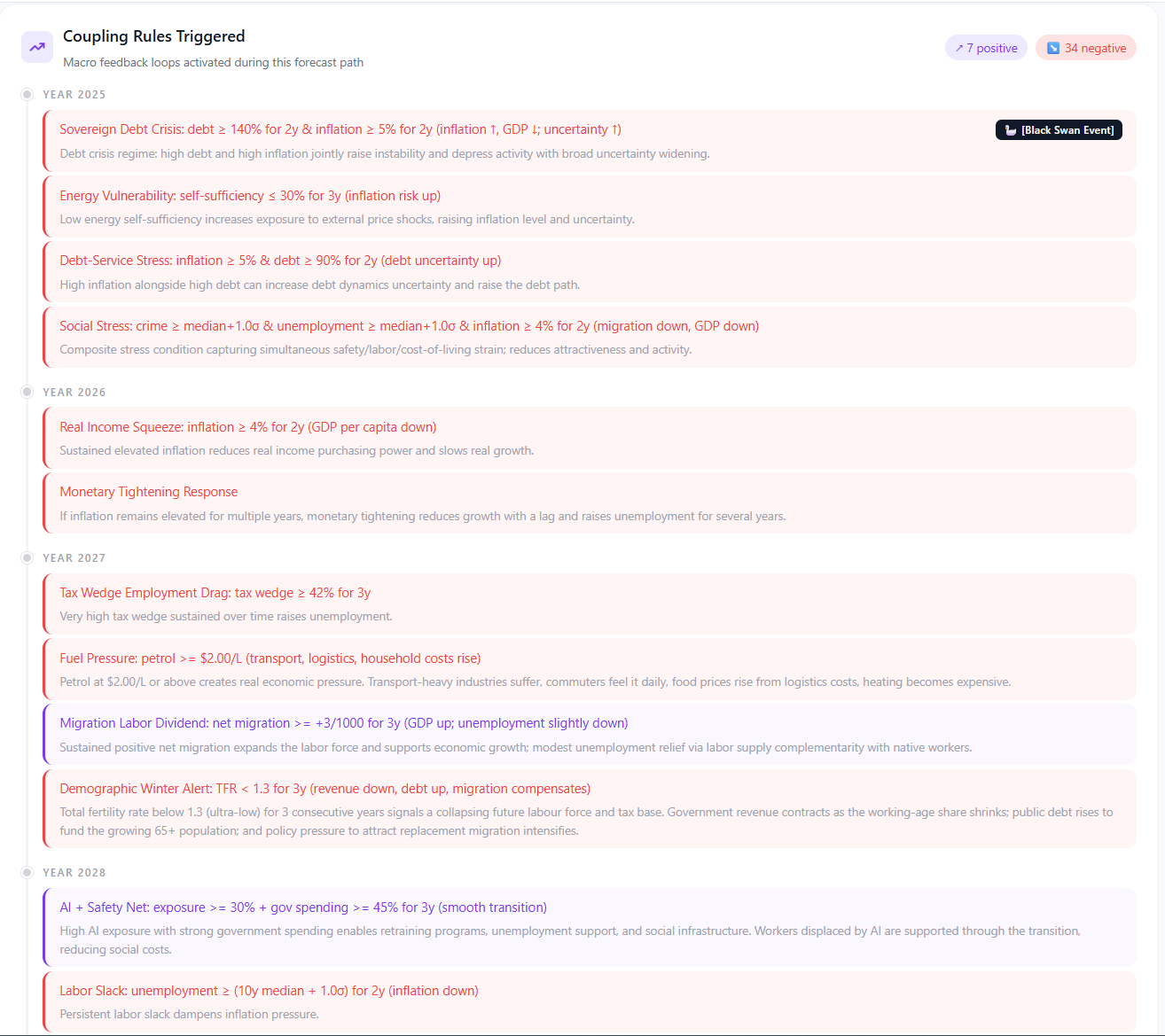
worldsimlab.com/explore — 54 negative rules, BSE-03 Sovereign Debt Crisis fires Year 1
WorldSim Coupling Rules — BSE-03 Sovereign Debt Crisis, 54 negative rules
5

Stressed vs Baseline: Fiscal Score Collapses from 42 to 17

The Comparison Engine puts the stressed Italy (TI 0.43) against the baseline (TI 0.44). Because the tilts revert after 5 years, the 2040 comparison shows partial recovery; the headline gap is just 1 point. But the structural scars are visible in two domains: Fiscal drops from 42 to 37 (the debt overshoot leaves a lasting mark), and Demographics collapses from 25 to 17 (the crisis accelerates brain drain and depresses fertility further). Income, Housing, Labour, Energy, and Technology converge back, confirming that the acute fiscal-demographic damage persists even after the macro shock passes.
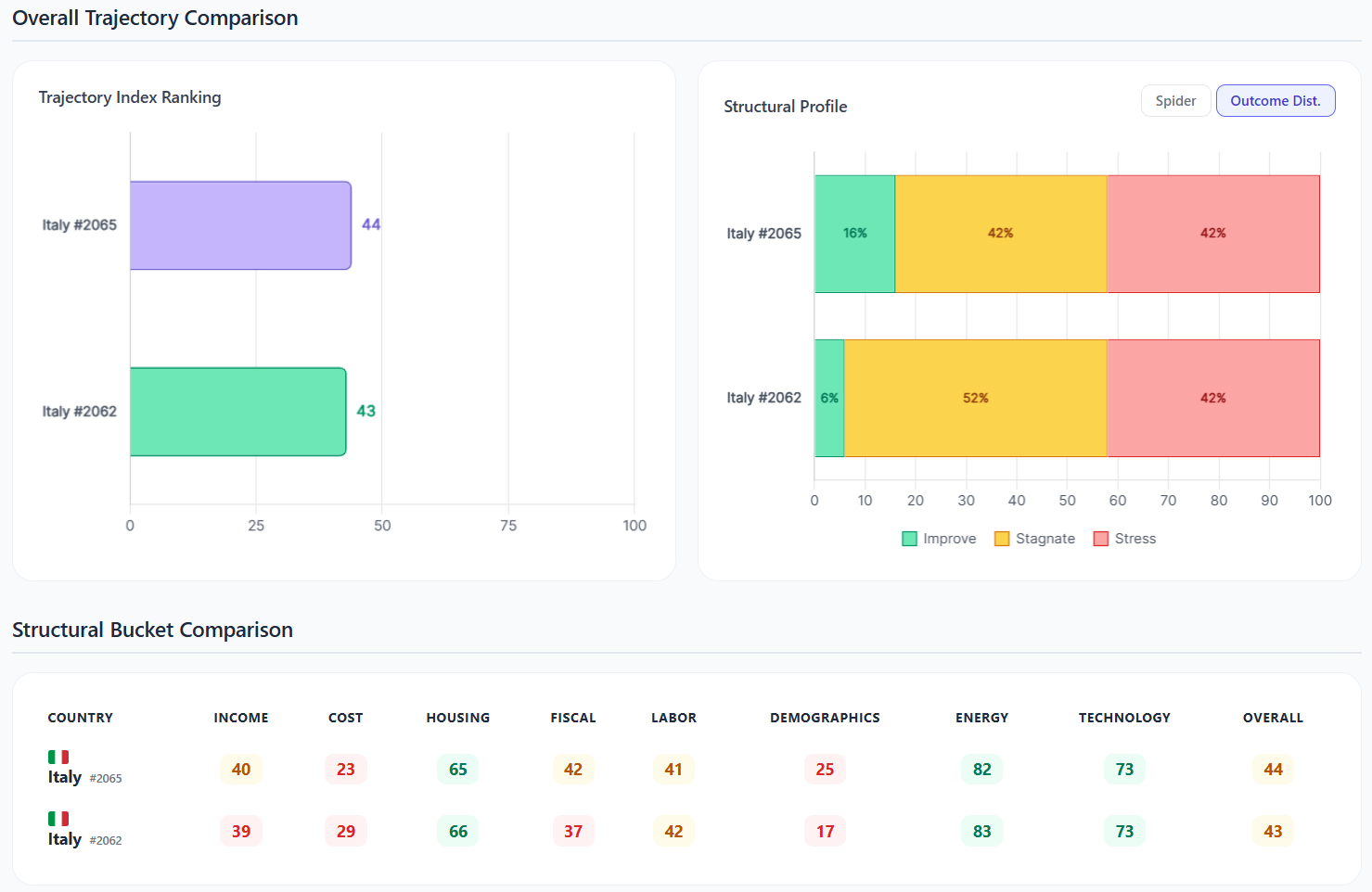
worldsimlab.com/compare — Stressed vs Baseline Italy, bucket scores + outcome bars
WorldSim Italy Comparison — Fiscal collapses 42 to 17, spider chart + bucket scores

Key Takeaway for Macro Investors

This scenario quantifies the Italian sovereign risk that the BTP-Bund spread is trying to price. The P50 median shows debt reaching 167% of GDP, serious but potentially manageable. The P90 tail shows 194%: restructuring territory. The coupling rules reveal that once BSE-03 (Sovereign Debt Crisis) fires, the cascade is self-reinforcing: debt-service costs rise, forcing austerity, which contracts GDP, which worsens the debt ratio further. A macro fund can use WorldSim to quantify not just the direction but the distribution of Italian sovereign risk under any rate + inflation + fiscal configuration, and compare it against any other country in minutes.

Quantify Your Macro Thesis

Run any trade idea as a structural scenario, with full distributional outputs across 26 KPIs and 195 countries.