Use Case: Governments

Fiscal Scenario Analysis for National Decision-Makers

Ministries of Finance, central banks, and national planning agencies need to understand how structural forces interact across a 25-year horizon, not in isolation, but as a coupled system.

WorldSim gives government institutions the infrastructure to stress-test policy decisions across thousands of simulated trajectories, quantifying the structural trade-offs that static models cannot capture.

The Status Quo

How Government Institutions Model the Future Today

Current tools give ministries a single line into the future. The real world delivers a distribution.

Bespoke Consultancy Reports

Commissions from Oxford Economics, Moody's, or Big 4 consultancies cost €50-200k per engagement and take 3-6 months. By delivery, the policy window may have closed.

IMF/EC Deterministic Projections

The IMF World Economic Outlook and European Commission forecasts provide single-line projections with no uncertainty bands, no structural coupling, and no scenario flexibility.

Internal DSGE Models

Central banks and treasuries run DSGE models that are expensive to maintain, slow to recalibrate, and opaque to non-technical policy staff. Most ministries don't have them at all.

Stability & Growth Pact Compliance

EU fiscal rules (reformed 2024) require medium-term structural fiscal plans. Current tools produce the plans but can't stress-test them under multiple structural scenarios simultaneously.

The WorldSim Approach

Structural Simulation for Government Decision-Making

WorldSim replaces months of consultancy with minutes of simulation, and gives you the full probability distribution, not just the consultant's best guess.

Fiscal Cascade Modelling

See how a debt increase cascades to tax pressure, which triggers emigration, which erodes the tax base, which increases debt further. 100+ structural coupling rules model these feedback loops automatically across every simulation path.

Full Probability Distributions

Every KPI output is a distribution (P10/P50/P90), not a point estimate. A ministry can see the optimistic, median, and pessimistic fiscal trajectory simultaneously, quantifying the uncertainty that deterministic models hide.

Policy Lever Testing

Tilt any structural variable: raise the tax wedge by 3pp, cut expenditure by 2% of GDP, or model an energy price shock. See the cascading effects across all 26 KPIs within minutes, not months.

Audit-Ready Reproducibility

Every simulation is deterministic per run group and fixed seed. The same configuration always produces identical results, meeting the governance standards required for parliamentary scrutiny, EU fiscal reporting, and institutional audit.

KPIs Most Relevant to Government Planning

GDP per capita Economic output
Public debt (% GDP) Fiscal sustainability
Gov. expenditure (% GDP) Spending pressure
Gov. revenue (% GDP) Tax base
Tax wedge (avg worker) Labour competitiveness
Unemployment rate Labour market
Inflation rate Price stability
Interest rate (policy) Monetary conditions
Net migration rate Population dynamics
Population share 65+ Ageing pressure
Total fertility rate Long-run demographics
Scenario Configurations

Questions WorldSim Answers for Governments

Each question below is a scenario configuration you can run in WorldSim, producing full probability distributions across all affected KPIs.

FISCAL SUSTAINABILITY

What if public debt exceeds 120% of GDP while inflation stays above 4%?

Models the compound fiscal trap: rising debt service costs, forced austerity, GDP contraction, and the debt spiral that trapped Greece from 2010-2015. Coupling rules propagate the cascade to tax revenue, expenditure, and emigration.

TAX POLICY

If we raise the tax wedge by 3 percentage points, what happens to unemployment and emigration over 10 years?

OECD evidence shows a 1pp tax wedge increase raises unemployment by 0.3-0.5pp. WorldSim models the full cascade: higher taxes, reduced competitiveness, brain drain, eroded revenue base. This is the feedback loop that constrains fiscal policy.

DEMOGRAPHIC PRESSURE

What's the fiscal impact of our ageing population hitting 25% elderly by 2035?

The EU Ageing Report estimates +0.3-0.5pp of GDP in additional public spending per 1pp increase in elderly share. WorldSim couples this to pension costs, healthcare demand, tax base erosion, and the immigration needed to offset it.

AUSTERITY vs STIMULUS

If we cut government expenditure by 3pp of GDP, what's the GDP multiplier under current conditions?

Blanchard & Leigh (2013) showed fiscal multipliers of 1.0-1.7 during recessions, twice what was assumed. WorldSim models the multiplier dynamically based on current economic conditions, not a fixed assumption.

ENERGY TRANSITION

What happens to our fiscal position if energy costs stay high while we invest in infrastructure?

The German Schuldenbremse debate in practice: relaxing the debt brake for green investment while energy prices squeeze households and industry. WorldSim models the interaction between energy costs, inflation, fiscal space, and growth.

RECESSION PREPAREDNESS

What happens to our tax revenue if GDP contracts 3% for two consecutive years?

Models the automatic stabiliser cascade: GDP falls, revenue drops, unemployment rises, social spending increases, debt accelerates. This is the fiscal deterioration that turns a recession into a structural crisis if not managed.

Real-World Context

Why This Matters Now

European governments are facing compounding structural pressures that interact in ways no static model can capture.

GREECE 2010-2015

The Sovereign Debt Cascade No Model Predicted

Debt rose from 109% to 179% of GDP. Unemployment hit 27.5%. GDP fell 26% cumulative. The cascade of austerity, recession, emigration, and further revenue collapse was invisible to the deterministic models used at the time. WorldSim's coupling rules model exactly this feedback loop.

GERMANY 2022-2025

Energy Crisis Meets the Debt Brake

The 2022 energy shock exposed Germany's structural vulnerability: high energy import dependence, €0.40+/kWh electricity prices, and a constitutional debt brake limiting fiscal response. The Schuldenbremse reform debate is fundamentally a structural scenario question that WorldSim can model.

EU FISCAL RULES 2024

New Stability & Growth Pact Requires Structural Plans

The reformed EU fiscal framework (2024) requires member states to submit medium-term structural fiscal plans. These plans need to demonstrate debt sustainability under various conditions: exactly the kind of structural scenario analysis WorldSim produces.

EU DEMOGRAPHIC WINTER

23 of 27 EU Members Below Replacement Fertility

Fertility rates below 1.3 in Italy, Spain, Greece, and most of Eastern Europe. The fiscal implications compound over 20-30 years: pension costs, healthcare demand, shrinking tax base, and the immigration policy needed to offset it. WorldSim models these interactions across the full horizon to 2050.

Scenario Walkthrough

Germany: Energy Crisis + Fiscal Expansion

What happens to Germany's structural position if energy costs stay elevated while the government relaxes the debt brake for infrastructure investment? We ran this exact scenario in WorldSim.

Scenario Configuration

Country
Germany
Scenario Path
As Planned
Simulations
5,000 trajectories
Persistence
5 years
Applied Tilts
Electricity price +8σ ($0.40 → $0.72, +79%) Energy self-sufficiency -5σ Gov. expenditure +5σ (49% → 52% GDP)
1

The Structural Overview: Trajectory Index 0.47, Stagnating Economy

WorldSim assigns Germany a Trajectory Index of 0.47 under this scenario. 59% of simulated paths lead to stagnation, 30% to structural stress, and only 11% show improvement. The 9-domain scorecard reveals where the pressure concentrates: Cost of Living (TI 0.22) and Housing Affordability (TI 0.16) are the worst-performing domains.
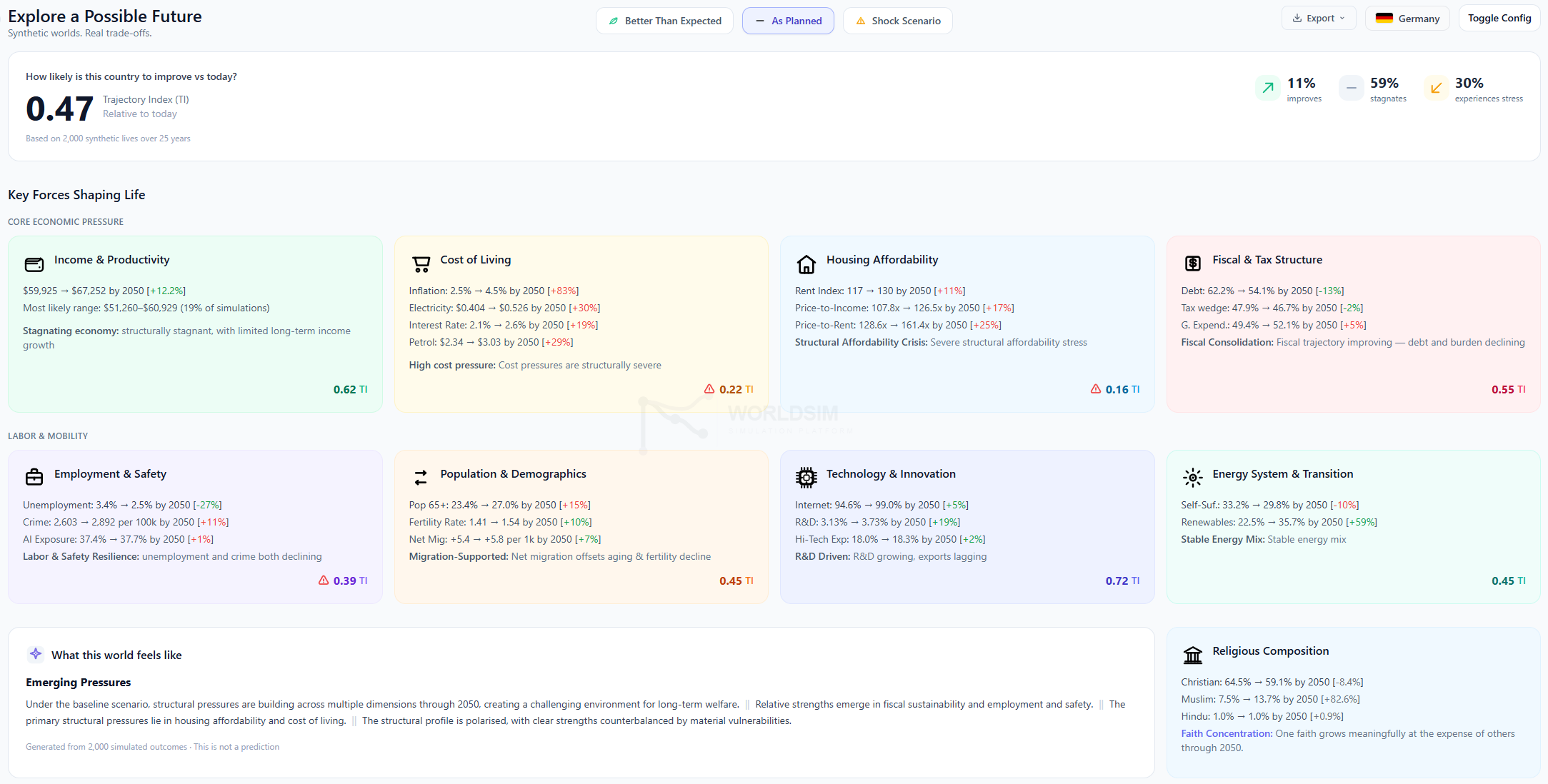
worldsimlab.com/explore — Germany, As Planned, 5,000 simulations
WorldSim Germany Scenario Overview — 9 domain scorecards with Trajectory Index 0.47
2

Cost of Living Impact: Inflation Doubles, Petrol Hits $3.03/L

The energy shock cascades directly into consumer prices. Inflation rises from 2.3% to 4.5% (P50 median), with a pessimistic P90 of 6.7%. Electricity prices surge 30% to $0.53/kWh. Petrol reaches $3.03/litre at the median, with the P90 tail hitting $4.77/L. This is the cost-of-living crisis that German households would face.
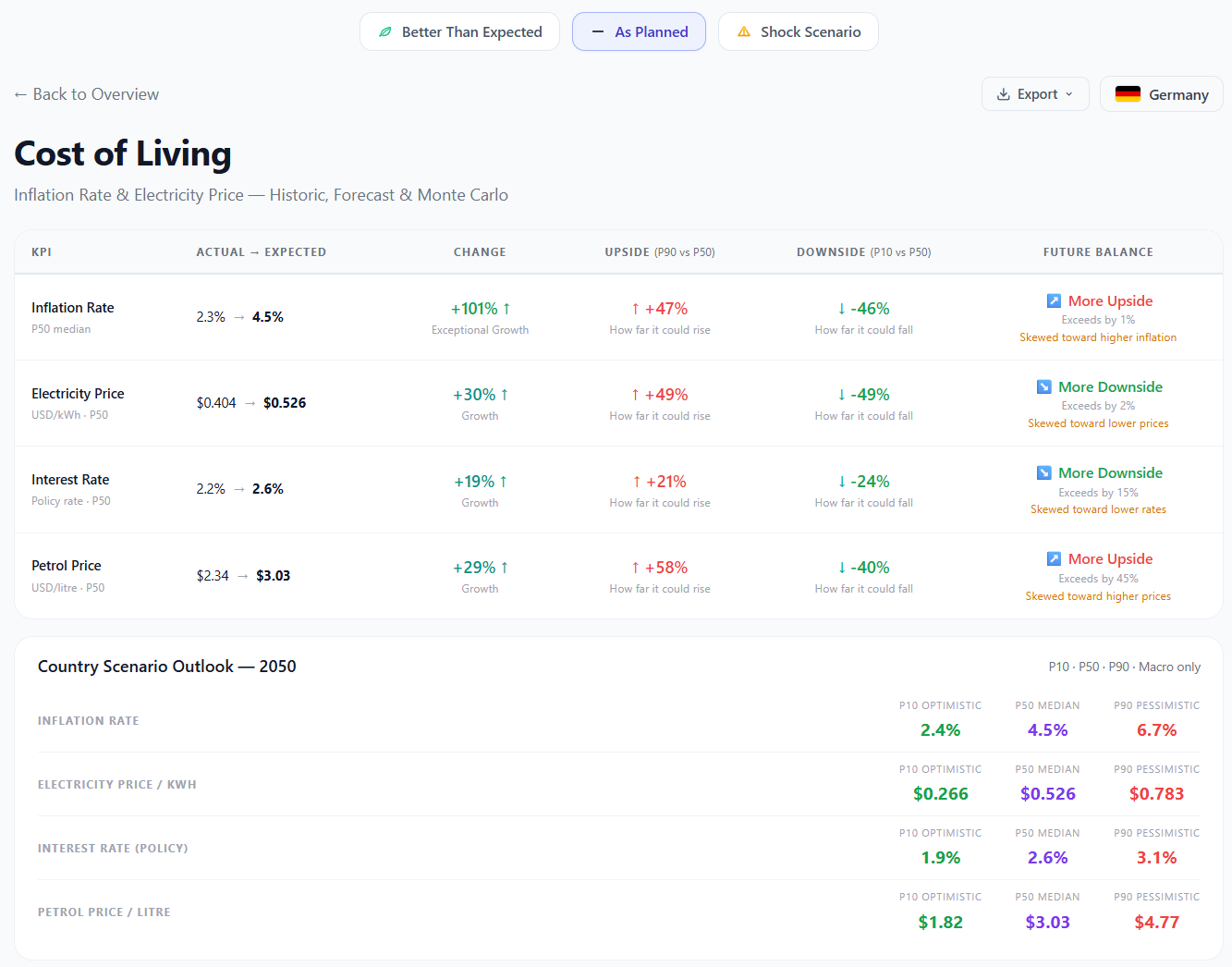
worldsimlab.com/drilldown/cost-of-living — P10/P50/P90 quantile outputs
WorldSim Germany Cost of Living Drilldown — Inflation, Electricity, Petrol with P10/P50/P90
3

Why This Happens: 39 Structural Rules Fire Across the Simulation

WorldSim's coupling rules engine shows exactly how the shock propagates year by year. Energy Vulnerability fires in 2025. By 2027, Fuel Pressure ($2.30/L threshold) and Tax Wedge Drag activate. By 2028, Energy Poverty Alert triggers. By 2031, Fuel Crisis ($2.60/L) and Mortgage Stress fire. 39 negative rules vs 18 positive: the structural feedback loops that a deterministic model would never show.
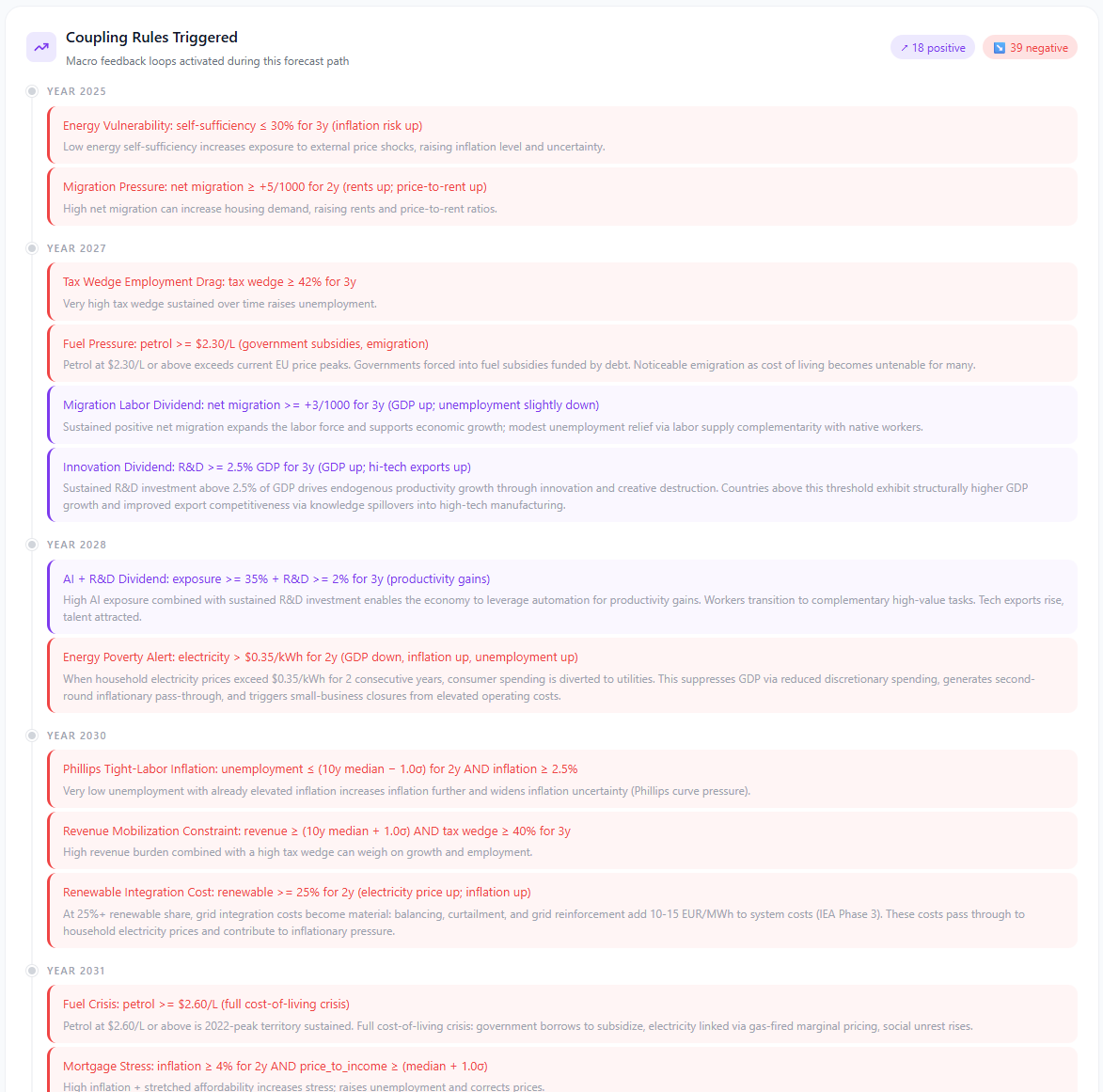
worldsimlab.com/explore — Coupling Rules Triggered (year-by-year audit trail)
WorldSim Coupling Rules Timeline — 39 negative, 18 positive rules firing 2025-2037
4

The Fiscal Consequence: Expenditure Rises, Debt Risk Skews Upward

Government expenditure rises from 49.4% to 52.1% of GDP (P50). While the median debt trajectory shows consolidation (62.2% → 54.1%), the distribution tells the real story: the P90 pessimistic scenario shows debt at 84.3% of GDP, a 22pp spread between optimistic and pessimistic outcomes. This is the fiscal uncertainty that the Schuldenbremse debate needs to quantify.
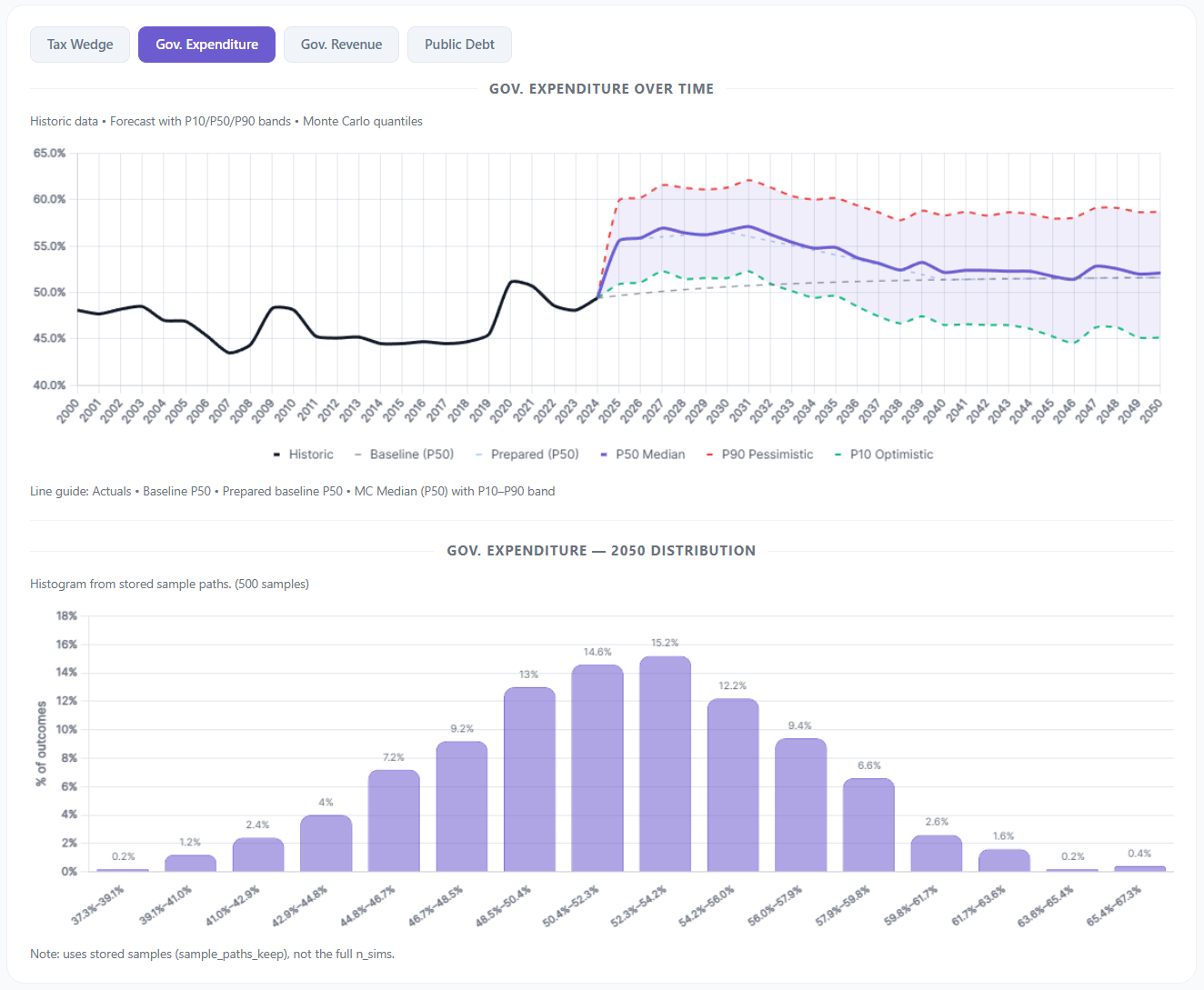
worldsimlab.com/drilldown/fiscal-tax — Gov Expenditure fan chart + 2050 distribution
WorldSim Germany Fiscal Drilldown — Expenditure, Revenue, Debt with fan chart and histogram
5

Stressed vs Baseline: Quantifying the Structural Damage

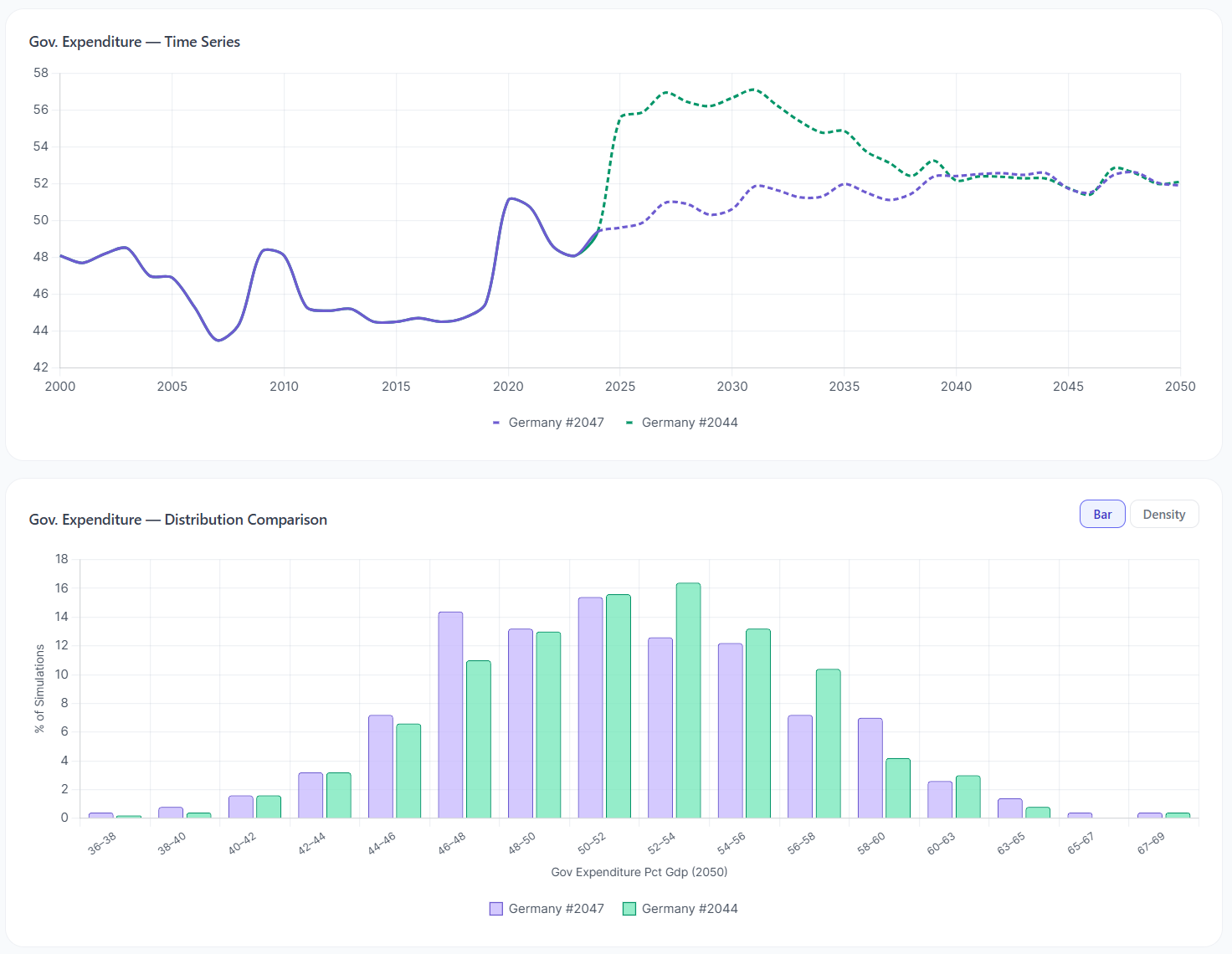
WorldSim's Comparison Engine puts the energy-stressed scenario (TI 0.47) side by side with the baseline Germany (TI 0.52). Because the tilts persist for 5 years and then revert, most domains recover to baseline by 2050; Cost, Housing, Fiscal, Demographics, Energy, and Technology are virtually unchanged. The lasting structural scar is in Income: the bucket score drops from 86 to 62, a 24-point permanent loss that persists even after energy prices normalise. This is the key insight for fiscal planners: a temporary energy shock leaves a permanent GDP mark. The Gov Expenditure time series confirms the acute phase: spending spikes above 55% of GDP during 2027-2032 before converging back, but the distribution remains wider than baseline, reflecting lasting fiscal uncertainty.
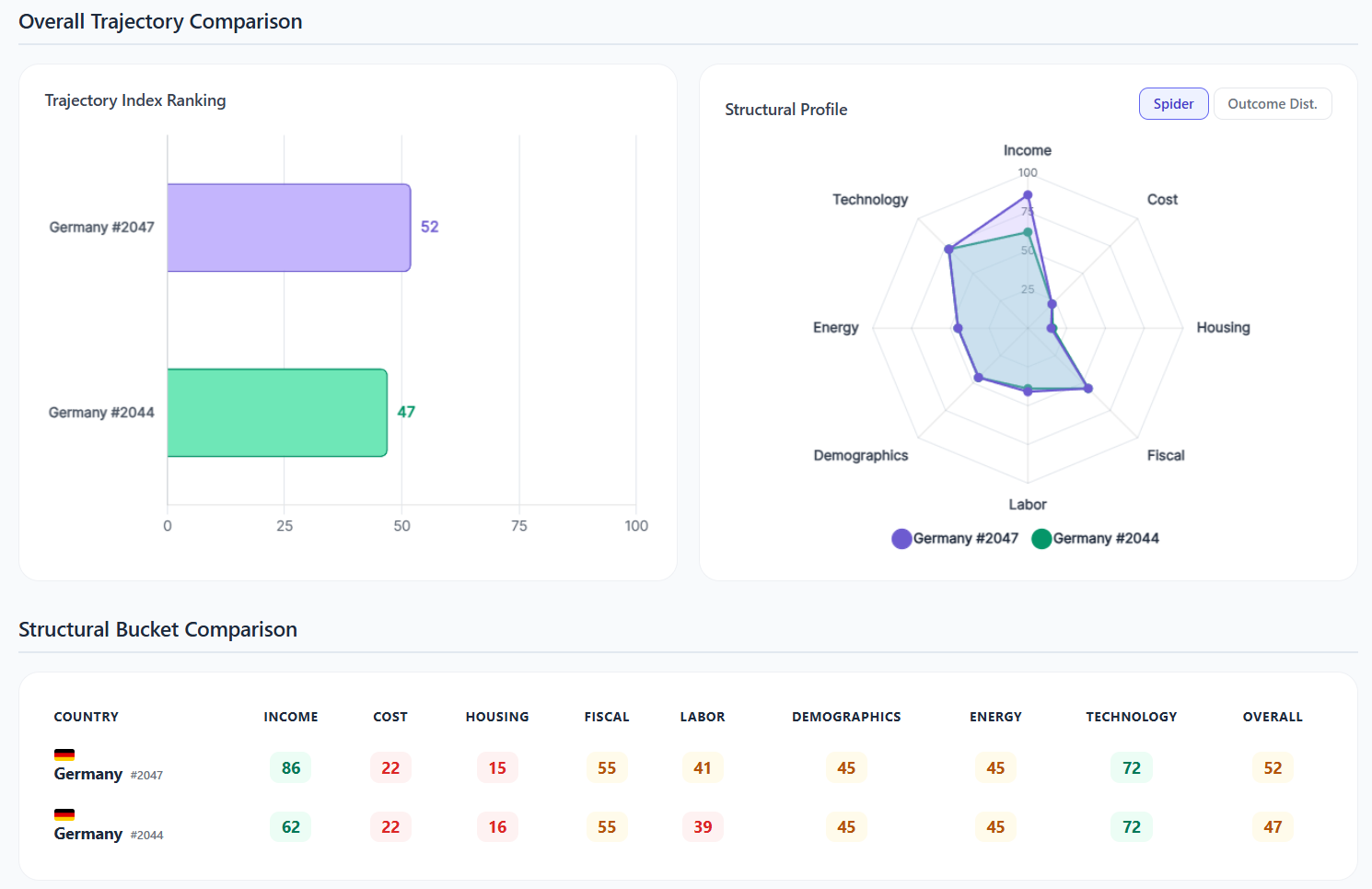
Trajectory Index + Structural Profile
WorldSim Comparison: Stressed vs Baseline Germany — TI and spider chart
Gov Expenditure: Time Series + Distribution
WorldSim Gov Expenditure Comparison — time series and distribution overlay

Key Takeaway for Government Decision-Makers

This scenario demonstrates what no deterministic model can show: the distribution of fiscal outcomes under structural stress. The median path is manageable, but the tail risk (P90) reveals a scenario where energy costs, inflation, and fiscal expansion interact to produce debt trajectories 22 percentage points higher than the optimistic case. A Ministry of Finance using WorldSim can quantify this tail risk before committing to a fiscal strategy, compare it directly against the baseline, and test alternative configurations, including different expenditure levels, different persistence assumptions, and different energy transition pathways, in minutes rather than months.

Stress-Test Your Fiscal Policy

Run structural scenarios across 195 countries, from baseline projections to full Monte Carlo distributions with 100+ coupling rules.