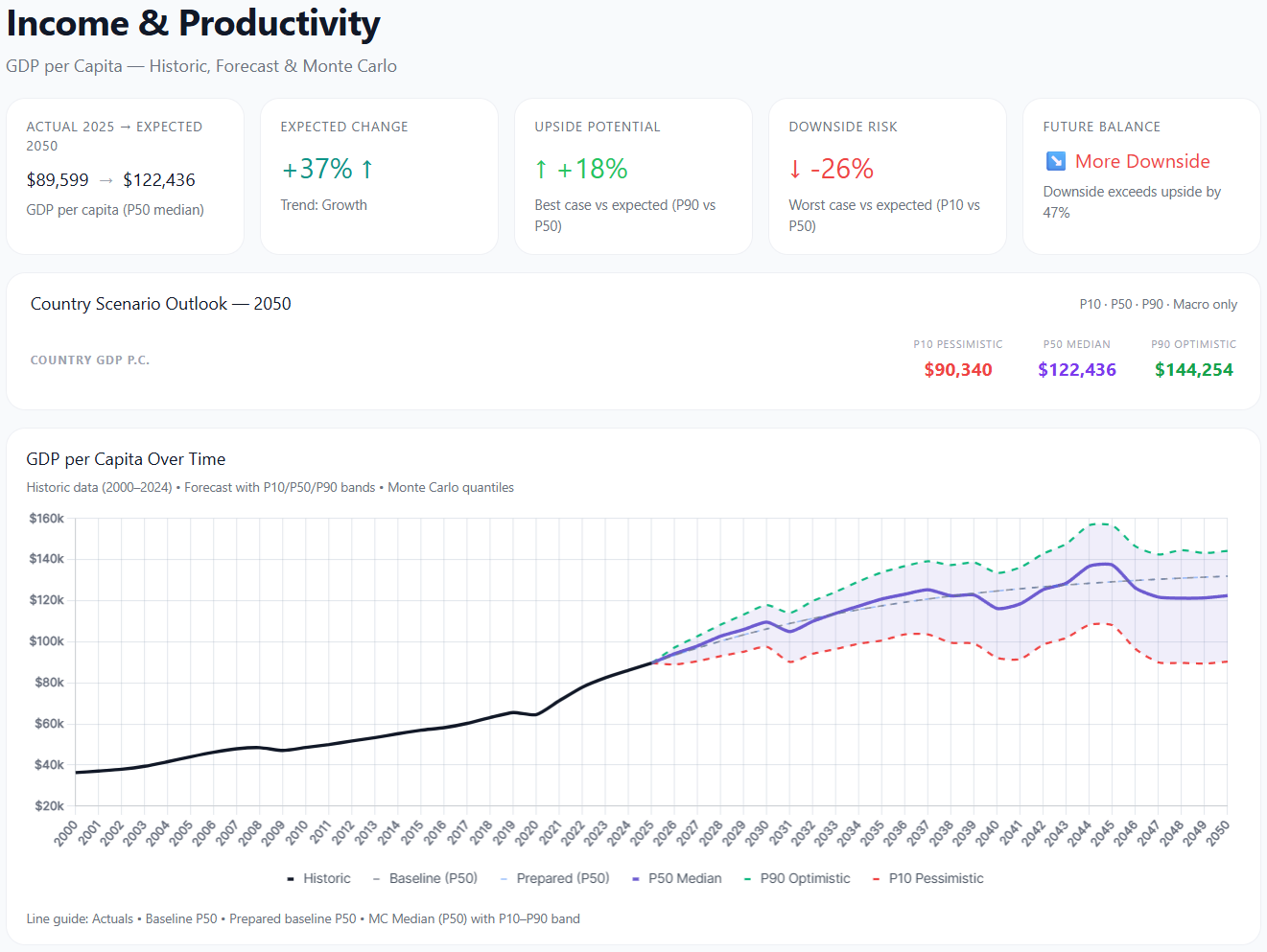
The EU AI Act (Regulation 2024/1689) requires high-risk AI systems to demonstrate robustness across deployment environments, coverage of reasonably foreseeable risks, and assessment of systemic impact. For AI operating in economic contexts, this means testing under diverse macro conditions.
WorldSim provides the structured, reproducible macro scenario environments that Articles 9, 10, 15, and 55 require. Not the full compliance stack, but the essential macro testing layer that no other tool provides.
Current AI compliance tooling covers bias testing, documentation, and model cards. The macro-scenario robustness layer is missing.
Each capability maps directly to a specific AI Act obligation. Together they form the macro scenario compliance layer.
What the Act requires: AI systems must be resilient to errors, faults, or inconsistencies in the operating environment.
What WorldSim provides: Structured macro environments representing recession, stagflation, energy crisis, demographic shift, and other conditions your AI will encounter. Run your model against each environment and document whether performance stays within tolerance. 5,000+ simulated paths per scenario give you statistical confidence, not just one stress test.
What the Act requires: Providers of GPAI with systemic risk must assess impact on "financial or economic stability" and perform adversarial testing.
What WorldSim provides: Structured scenarios showing how AI-driven decisions cascade through economic systems. Model what happens when AI displacement hits 35% with low R&D investment. Simulate the structural consequences of automated financial decision-making at scale. The coupling rules show exactly how macro variables interact, providing the causal framework that systemic risk assessment demands.
What the Act requires: Identify and test against "reasonably foreseeable risks," with testing against "prior defined metrics and probabilistic thresholds."
What WorldSim provides: A structured library of macro scenarios that defines "reasonably foreseeable" for economic contexts. Recession, energy shock, inflation spike, demographic pressure, fiscal crisis: each is a named, reproducible scenario configuration. For conformity assessment, you can document exactly which scenarios were tested, with what parameters, producing what distributional outcomes. The audit trail is built in.
What the Act requires: Test data must reflect "the specific geographical, contextual, behavioural, or functional setting" where the system will be used.
What WorldSim provides: An AI deployed across 27 EU member states faces fundamentally different economic conditions in each. Germany's electricity costs are 2.5x Poland's. Greece's debt is 3x Ireland's. Romania's demographics are opposite to Sweden's. WorldSim provides macro environments for all 195 countries with the same 26 KPIs, enabling systematic testing across the full diversity of deployment contexts.
What the Act requires: Risk management must be "continuous and iterative" throughout the AI system lifecycle, not just pre-deployment.
What WorldSim provides: A macro benchmarking layer for ongoing monitoring. Your model was validated under specific macro conditions (e.g. TI 0.52, inflation 2.3%, unemployment 3.4%). When real-world conditions shift significantly (TI drops to 0.38, inflation hits 6%), WorldSim flags that the deployment environment has moved outside the validated envelope. This triggers revalidation before the model degrades in production.
WorldSim doesn't feed directly into your model. It defines the macro environment that determines the statistical properties of your model's input population. Here's exactly how the connection works for each AI type.
WorldSim's role: defines the structured macro environment. The bank's existing stress testing infrastructure handles the macro-to-micro translation. WorldSim adds value by providing structurally coherent scenarios (not just "unemployment +5pp" in isolation, but the full coupled cascade), cross-country coverage (27 EU markets), and distributional output (P10/P50/P90, not just one stress point).
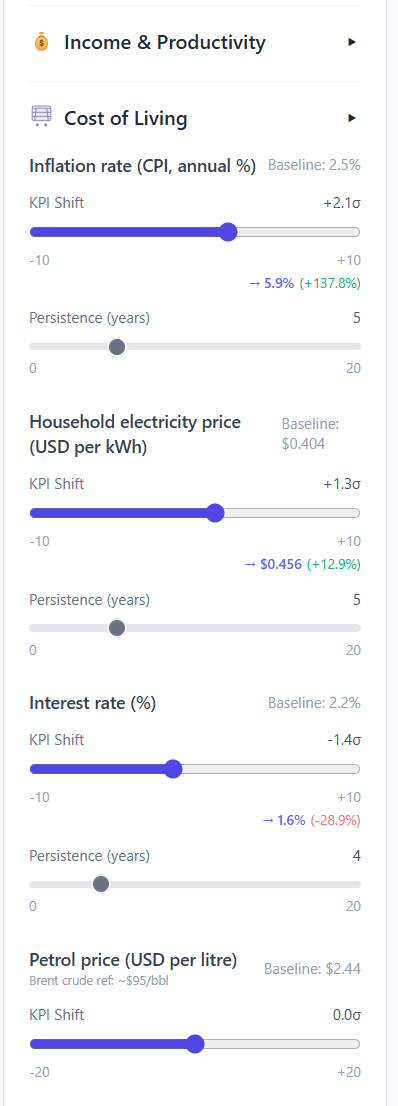
The bank configures macro tilts (inflation +2.1σ, electricity +1.3σ, rates -1.4σ) to define each stress scenario. Each tilt translates to real-world values shown in the sidebar.
WorldSim produces full distributional outputs (P10/P50/P90) for every KPI. For GPAI systemic risk assessment, these distributions quantify the range of economic outcomes that AI-driven decisions could influence or amplify.
Full AI Act compliance requires multiple tools. WorldSim is one essential layer, not the entire stack. Here's what you'll need from other providers.
Testing for fairness across protected characteristics (age, gender, ethnicity) requires personal-level demographic data and micro-level analysis. WorldSim operates at the macro level and does not assess individual-level bias.
Testing against adversarial attacks, data poisoning, and model manipulation requires specialised adversarial ML tooling. WorldSim tests environmental robustness (changing macro conditions), not adversarial inputs.
Article 10's data governance requirements include documenting training data sources, collection processes, and annotation methodology. This is an administrative and process challenge that requires data management tooling.
GPAI providers must comply with Union copyright law and publish training data summaries. This is a legal and data management obligation outside WorldSim's scope.
Technical documentation, instructions for use, and conformity declarations require documentation tooling and processes. WorldSim provides scenario test results that feed into this documentation, but doesn't generate the documentation itself.
Training a credit scoring or hiring model requires personal-level features (income, payment history, qualifications). WorldSim generates macro environments for testing, not personal-level training data.
The high-risk AI deadline is 2 August 2026. Start testing your AI systems against structured macro scenarios with full audit trail and reproducibility.