Corporate strategy teams making multi-billion euro investment decisions need to understand how a country's cost structure, labour market, and regulatory environment evolve over 10-15 years, not just where they stand today.
WorldSim quantifies the structural comparison that site selection consultants charge six figures for: energy costs, tax burden, labour availability, housing, and infrastructure trajectories across any two countries, with full probability distributions.
Current approaches are expensive, slow, and rarely model how cost structures interact over time.
Bespoke analysis costing €100-500k per engagement, taking 3-6 months. By delivery, the competitive landscape and policy environment may have shifted.
Qualitative risk assessments with narrative analysis. Useful for context, but no distributional output and no way to test "what if energy costs rise 30% after we invest."
Finance teams build comparison spreadsheets with IMF/World Bank data. Static assumptions, no structural coupling, and no uncertainty quantification. Energy, tax, and labour are analysed in silos.
Focused on rent, land costs, and logistics. Rarely model the macro structural environment that determines whether those costs rise or fall over the 15-year life of a factory or office investment.
WorldSim turns site selection into a quantified structural comparison with probability distributions and full domain coverage.
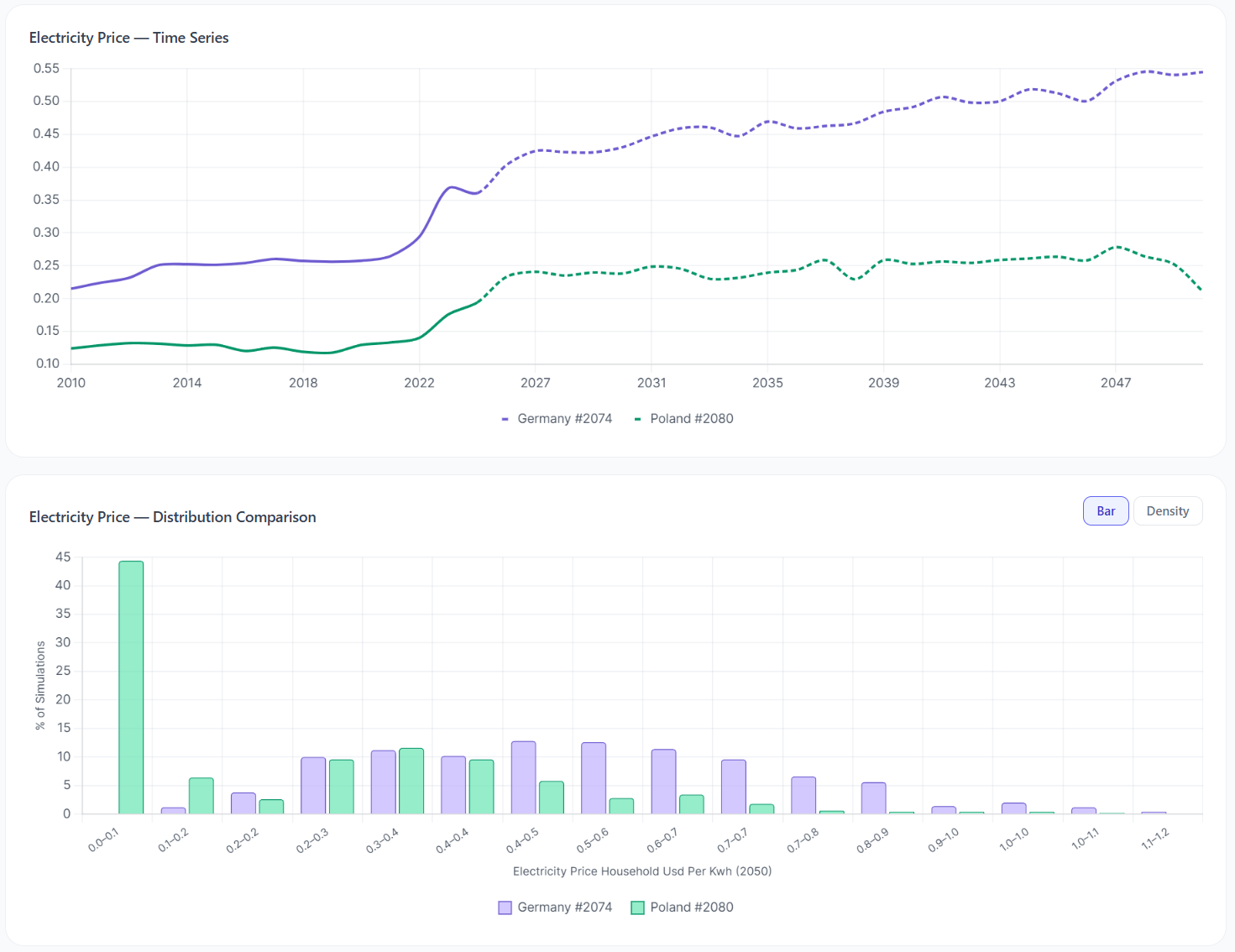
Compare electricity and petrol price paths across countries with P10/P50/P90 bands. Poland's electricity at $0.21/kWh vs Germany's $0.55/kWh is a 62% cost advantage today, but will it hold for 15 years? WorldSim models the trajectory, not just the snapshot.
The tax wedge captures the full cost of employing a worker, including social contributions. A 13.6pp difference between Poland (34.3%) and Germany (47.9%) translates directly to labour cost competitiveness, and WorldSim models how this gap evolves structurally.
A factory needs workers for 15-25 years. WorldSim flags the demographic risks that site selection consultants miss: Poland's 65+ share surges from 21% to 35% by 2050 while net migration turns negative. That's a labour supply crisis that will affect your investment thesis.
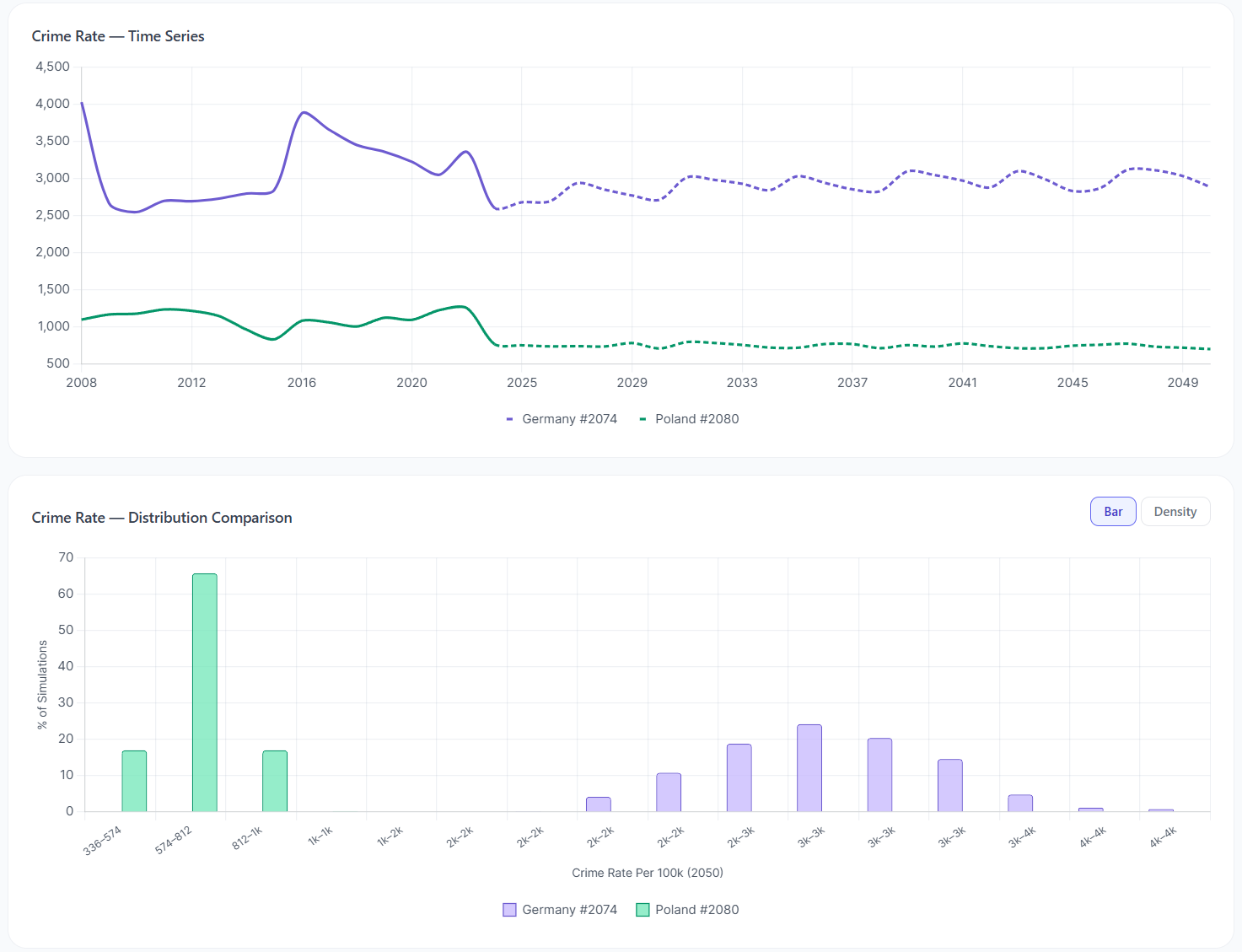
Crime rates, political stability, and operational risk matter for international investment decisions. WorldSim tracks crime per 100k alongside GDP and employment, giving a complete picture of the operating environment, not just the financial metrics.
Each question maps to a scenario configuration that produces the distributional comparison your board presentation needs.
Compare energy costs, tax wedge, labour availability, and infrastructure trajectories side by side. WorldSim produces the full distributional comparison across all cost-relevant KPIs simultaneously.
Tilt electricity prices and see how the structural coupling cascades to inflation, wages, employment, and migration. The P90 tail shows the worst-case cost scenario your CFO needs to plan for.
WorldSim models the demographic trajectory and its interaction with migration, unemployment, and fiscal pressure. A factory that needs workers for 20 years can't ignore the Demographic Winter signal.
The post-COVID nearshoring wave needs structural analysis, not just today's cost snapshot. WorldSim compares any set of countries across all cost-relevant dimensions with 25-year trajectories.
Higher inflation erodes the wage and cost differential that makes low-cost countries attractive. WorldSim models whether the convergence is fast enough to eliminate the advantage before your investment pays back.
Data centres need specific structural conditions: cheap, reliable power; high digital connectivity; favourable tax treatment. WorldSim screens all 195 countries against these criteria simultaneously.
Tesla chose Berlin for its European Gigafactory. Germany offers a skilled workforce and central location, but electricity costs ($0.40+/kWh), a 48% tax wedge, and housing affordability stress (TI 0.15) create structural headwinds. WorldSim would have quantified these risks before ground was broken.
Intel's planned €30B semiconductor fab in Magdeburg has been delayed and scaled back. Germany's energy costs, bureaucracy, and structural cost position raised questions about long-term viability. A WorldSim comparison of Germany vs alternative sites would have quantified the structural trade-offs.
Companies are relocating production from Asia to Central and Eastern Europe. Poland, Czechia, and Romania offer lower costs and EU single market access. But demographic decline, rising wages, and inflation convergence are structural risks that need quantification over 15+ years.
Financial services firms relocating from London chose between Dublin (low tax, English-speaking), Amsterdam (quality of life, connectivity), and Frankfurt (ECB proximity, labour pool). WorldSim's structural comparison would have quantified the 15-year cost and demographic trajectory of each option.
Two EU member states, baseline conditions, no tilts. The structural cost comparison that a site selection team needs, produced in minutes with full probability distributions.
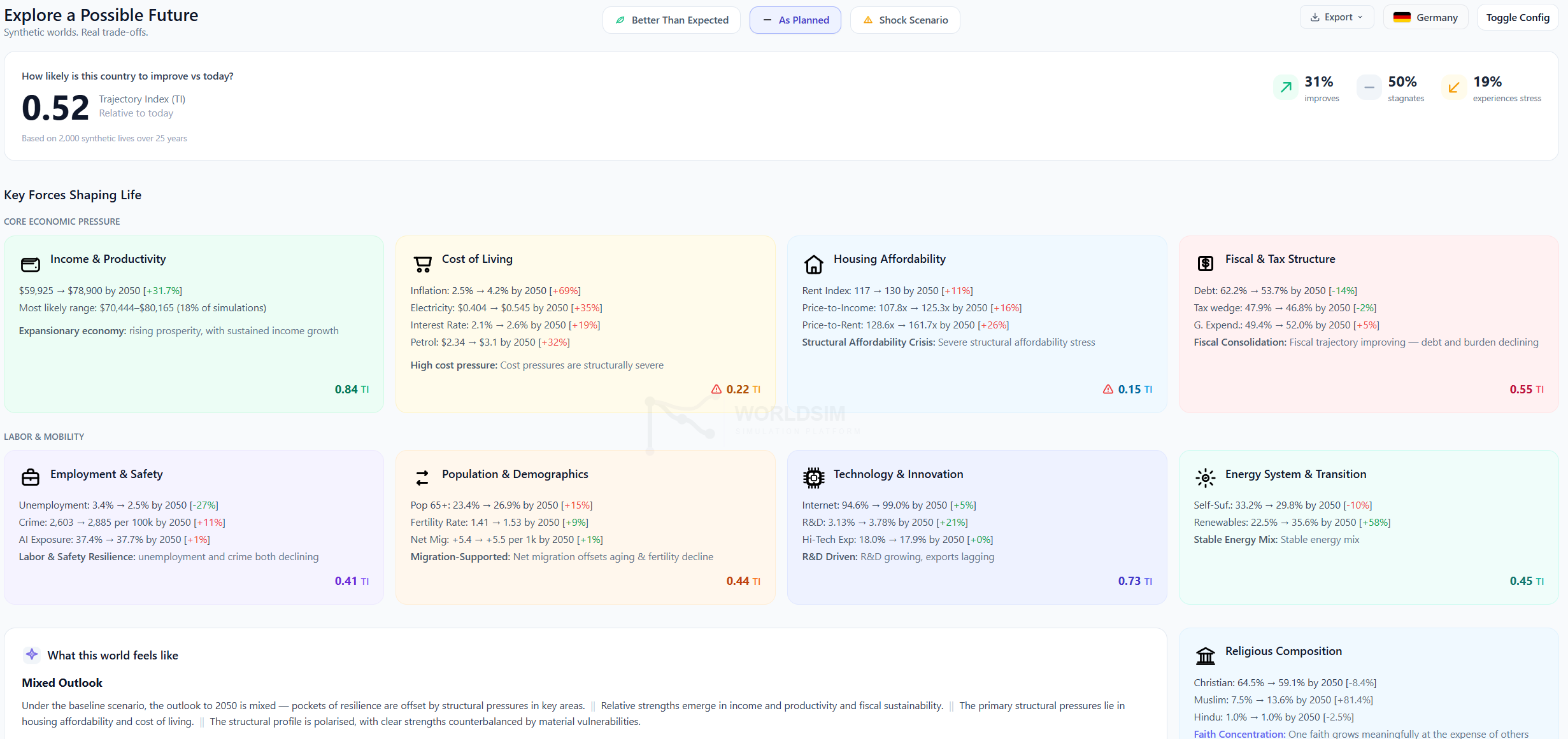
Germany delivers GDP growth of +31.7% ($59,925 to $78,900) with strong Income (TI 0.84). But the cost picture is concerning: electricity rises 35% to $0.55/kWh, petrol reaches $3.10/L, and inflation hits 4.2%. Housing Affordability collapses to TI 0.15 (rent +11%, price-to-income +16%). The tax wedge remains high at 46.8%. Germany is a high-productivity, high-cost environment where margins are squeezed structurally.
Poland offers faster GDP growth (+41.1%, $28,485 to $40,194) from a lower base, with significantly cheaper electricity ($0.21/kWh, 62% below Germany) and a 13.6pp lower tax wedge (34.3% vs 47.9%). But Poland faces a structural demographic crisis: the 65+ share surges from 20.8% to 34.6% (+67%), fertility drops to 1.08, and net migration turns negative (-0.1 per 1,000). This "Demographic Winter" classification means the labour pool that makes Poland attractive today will shrink dramatically over your investment horizon.
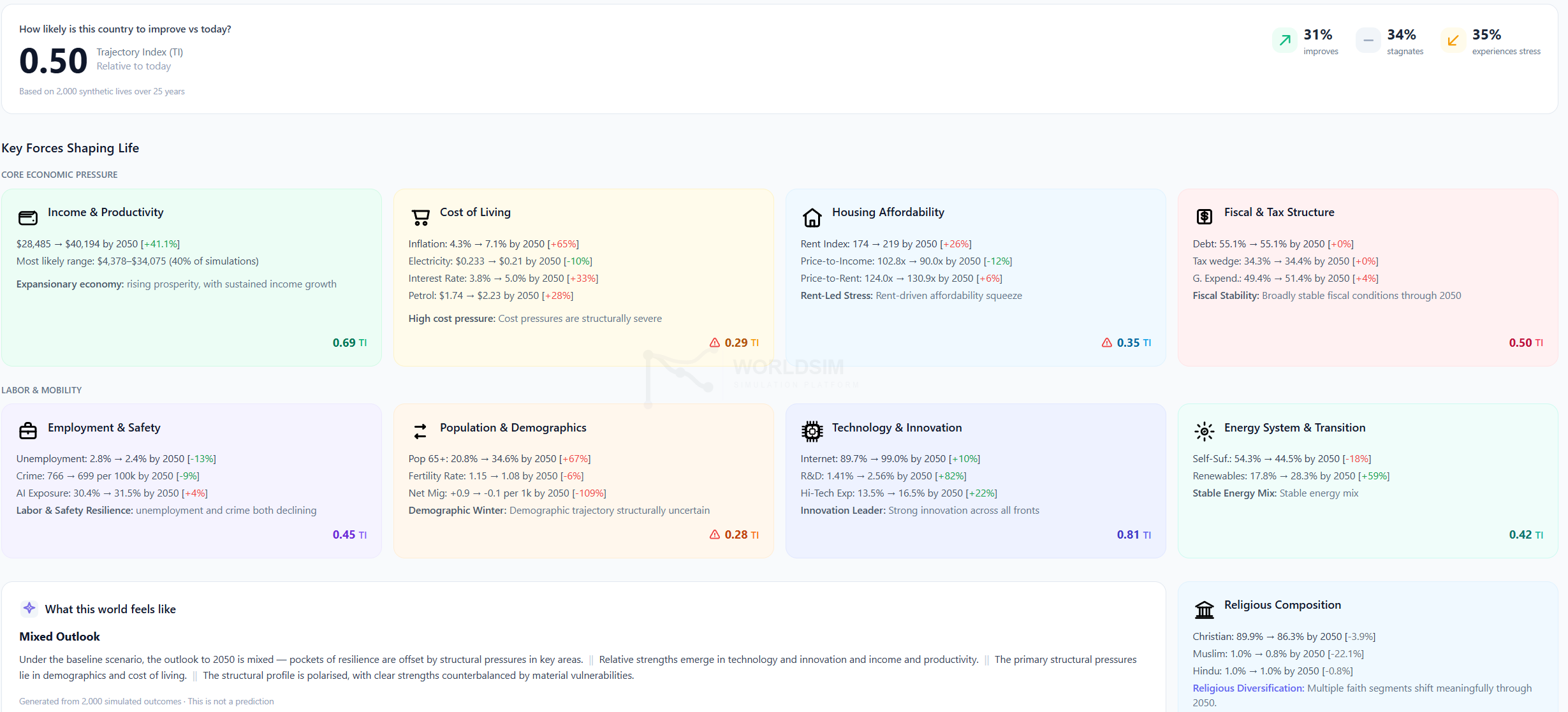
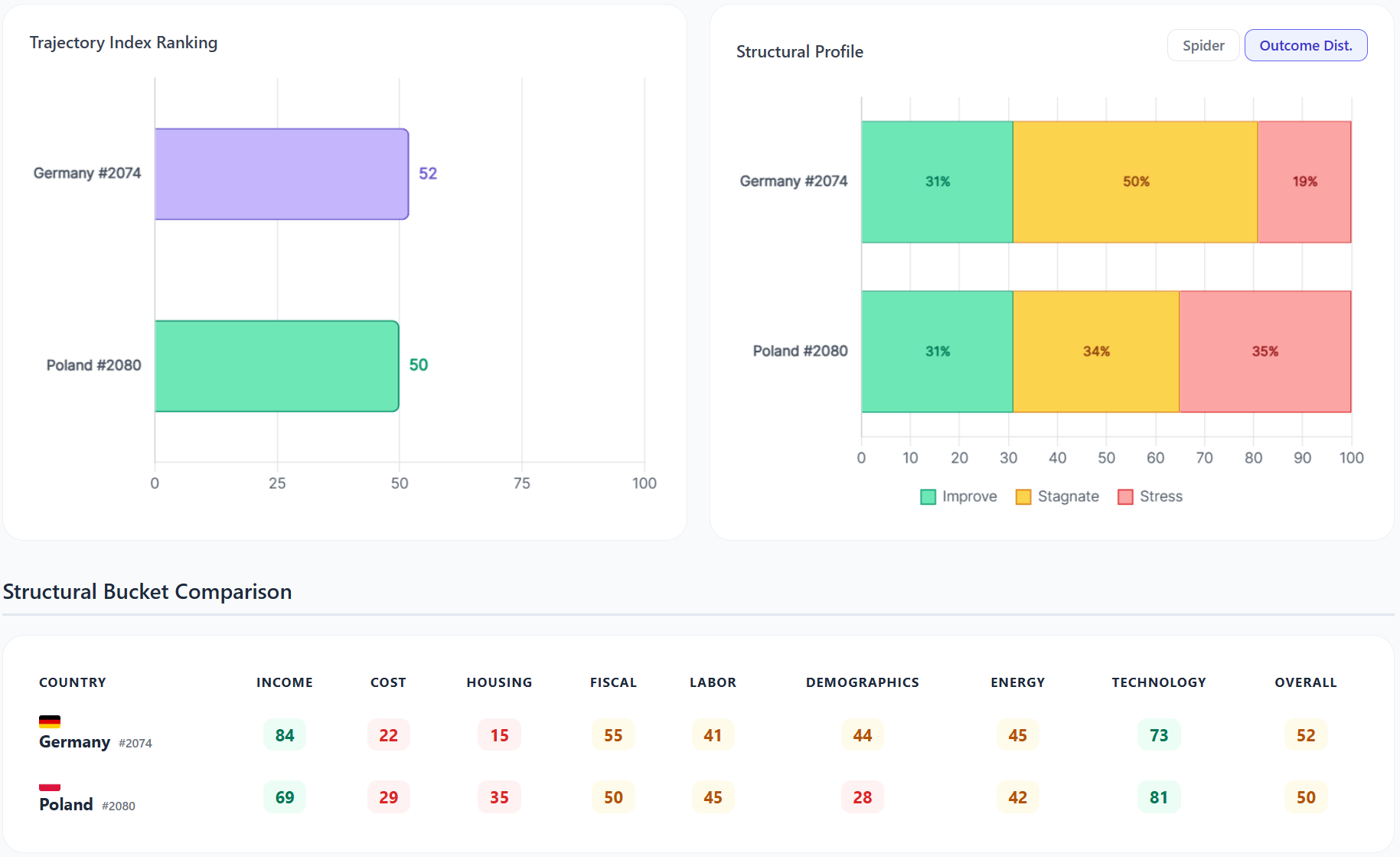
The Comparison Engine reveals the core trade-off. Germany leads on Income (84 vs 69) and Demographics (44 vs 28). Poland leads on Housing (35 vs 15), Technology (81 vs 73), and Labour (45 vs 41). Cost of Living is weak for both (22 vs 29). Overall TI is nearly identical (52 vs 50), but the structural profiles are fundamentally different: Germany is a high-cost, high-productivity play; Poland is a low-cost, high-growth play with demographic risk. The outcome bars show Germany has less stress risk (19% vs 35%).
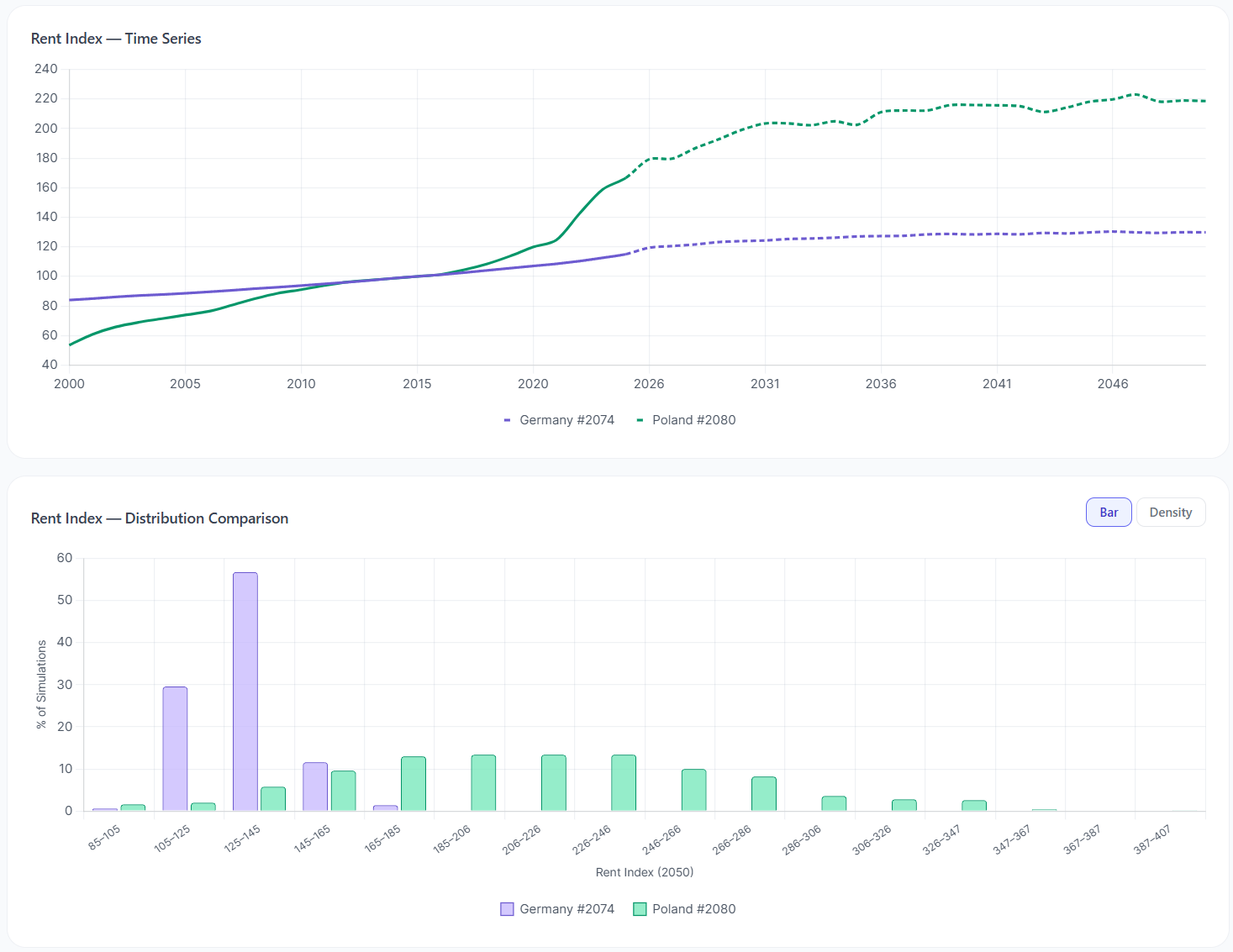
Three KPI deep dives tell the operational story. Electricity prices diverge dramatically: Germany's costs climb from $0.40 toward $0.55/kWh while Poland stays below $0.25, a persistent 2.5x cost advantage for energy-intensive manufacturing. Rent tells the opposite story: Poland's rent index surges past Germany's as its economy grows, eroding the office-cost advantage. Crime rates show Poland consistently safer (699 vs 2,885 per 100k), relevant for employee relocation and security costs.
Germany and Poland score nearly identically overall (TI 0.52 vs 0.50), but their structural profiles are fundamentally different. Poland wins on cost: 62% cheaper electricity, 13.6pp lower tax wedge, lower crime, and faster GDP growth. Germany wins on stability: better demographics (44 vs 28), lower stress probability (19% vs 35%), and a deeper labour pool. The critical risk for Poland is demographic: a 67% increase in the 65+ share and negative net migration by 2050 means the cheap labour that attracts investment today may not be available tomorrow. A corporate strategy team using WorldSim can quantify this trade-off with full distributional outputs, test "what if" scenarios on any cost variable, and present the board with a probabilistic investment case rather than a static spreadsheet.
Compare any two countries across energy costs, tax burden, labour supply, and 23 other structural indicators, with full probability distributions to 2050.