What the Data Looks Like
WorldSim covers 195 countries globally. Every simulation produces structured, multi-layered output that AI teams can consume as training data, test environments, or contextual inputs for LLM-based systems.
Global Coverage: 195 Countries, Same Depth
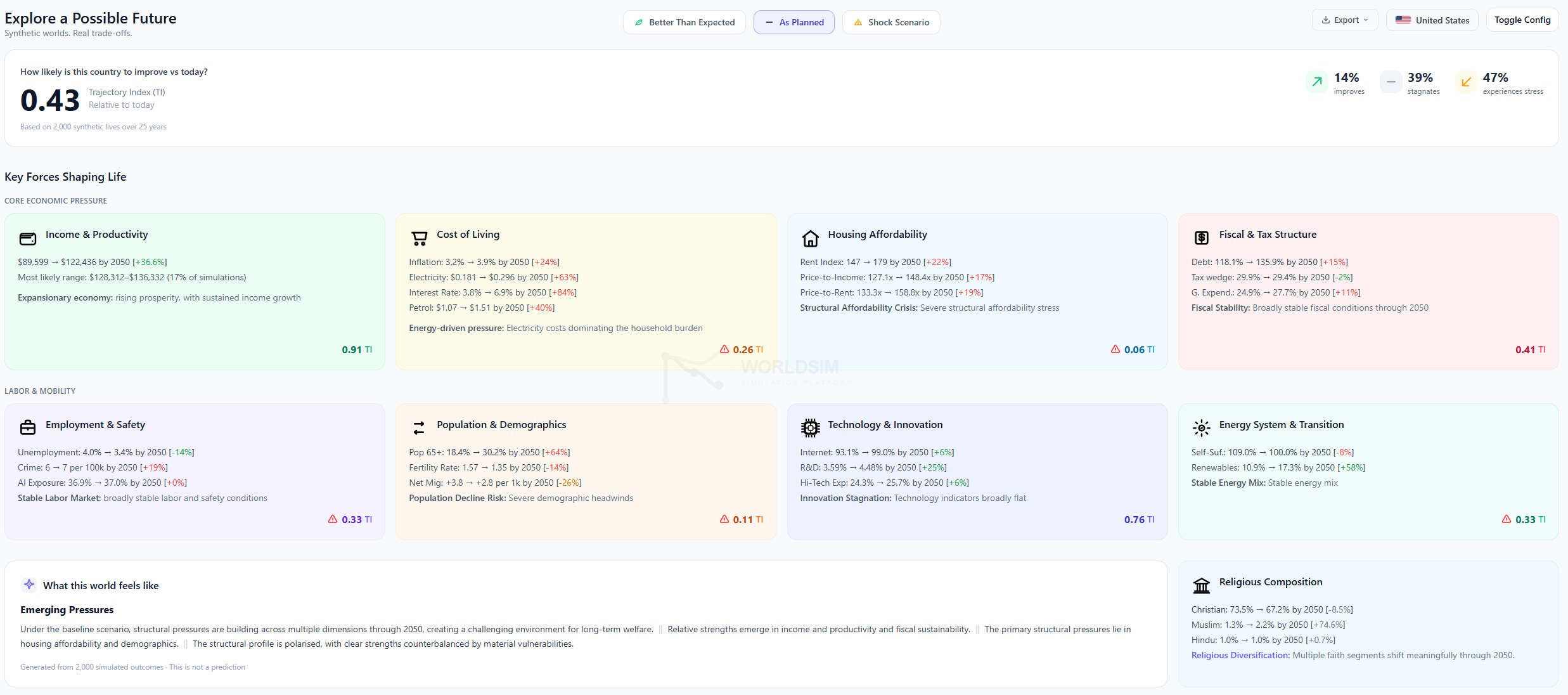
WorldSim isn't EU-only. Here's a US baseline simulation: TI 0.43, with 26 KPIs across all 9 structural domains. Every country in the database produces the same schema and depth of output, from the US to Bangladesh to Nigeria. AI teams training global models get globally diverse macro environments with consistent structure.
Raw Monte Carlo Paths: The Training Data
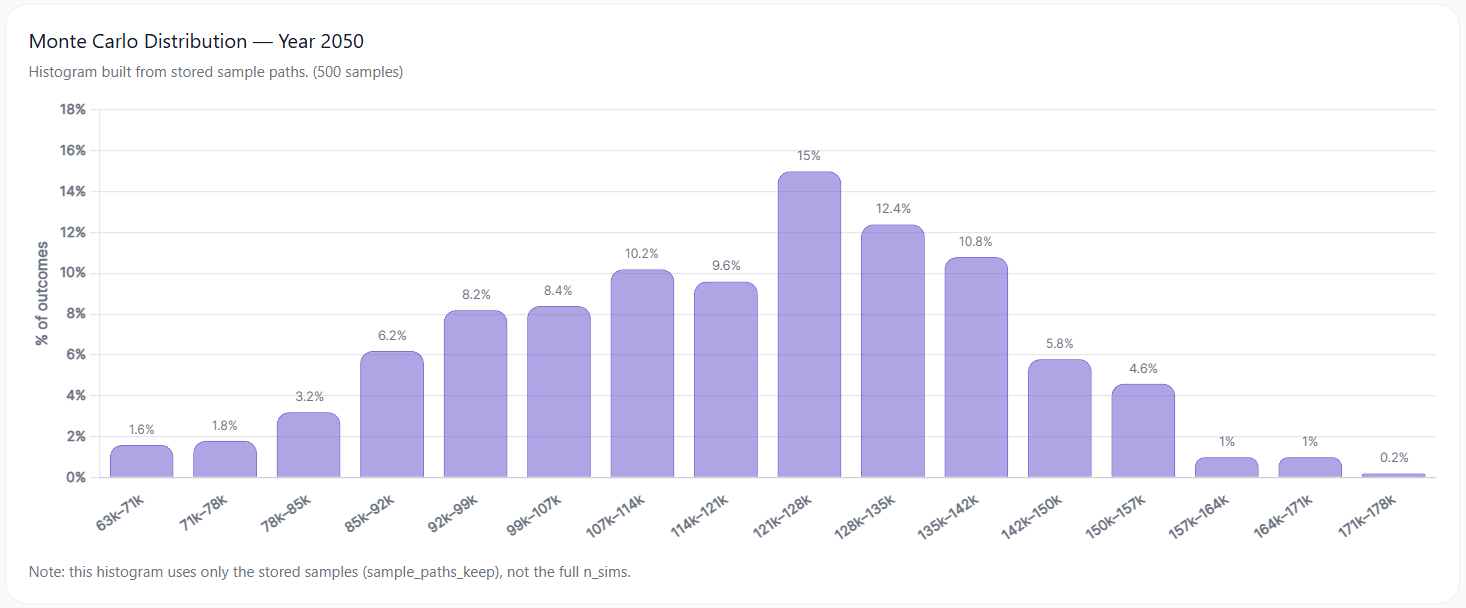
This histogram shows the distribution of US GDP per capita outcomes at 2050 across 500 stored sample paths. Each path is a complete 25-year trajectory with 26 KPIs. For Enterprise buyers, all paths (up to 10,000) are available as raw CSV/Parquet downloads. This is the underlying data that powers every chart, quantile, and regime classification. Your ML model trains on the paths; the distributions are the validation target.
Coupling Rules: Structured Context for LLMs
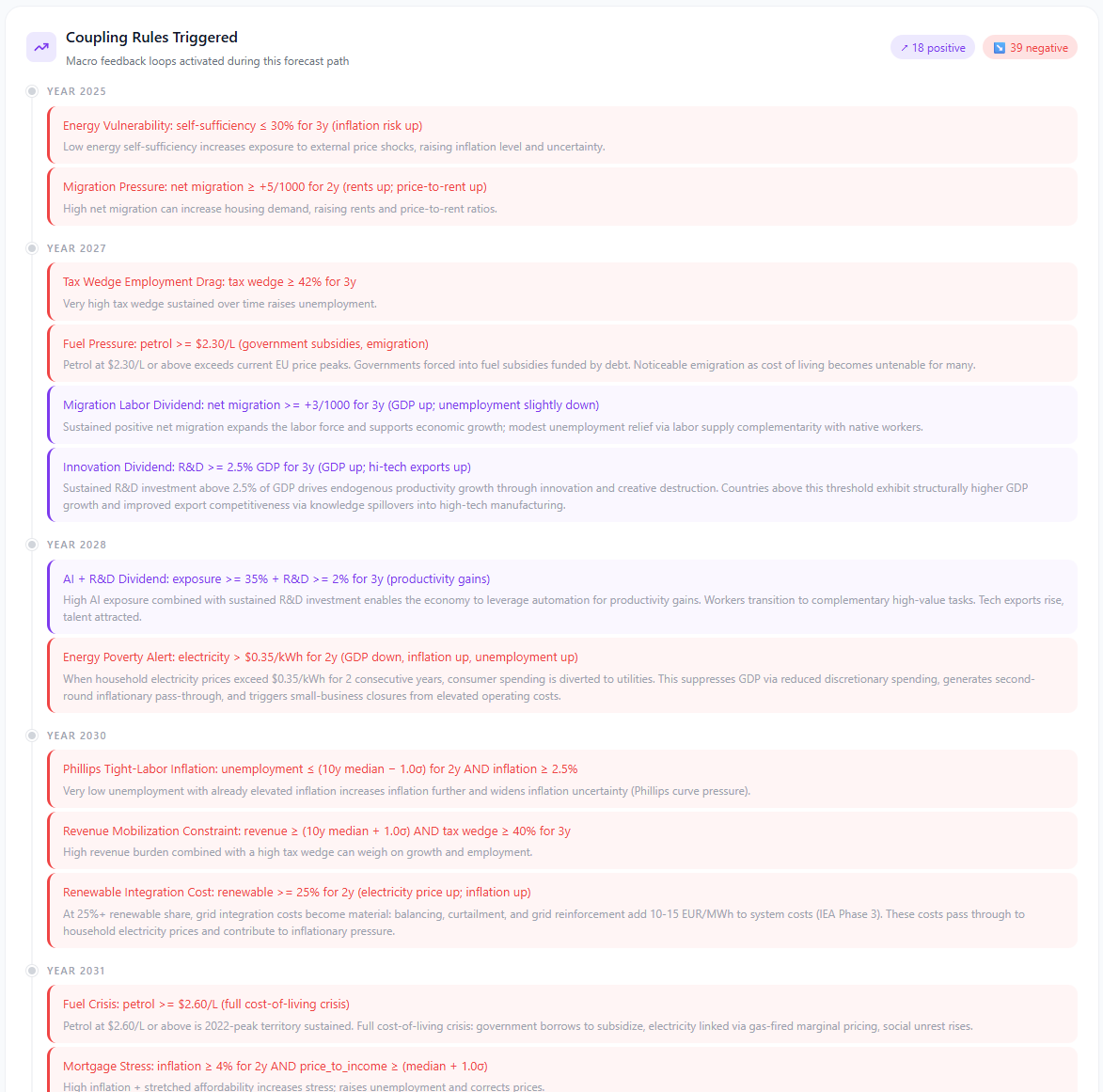
Every simulation path comes with a full log of which structural rules fired, when, and why. For LLM and descriptive AI systems, this is high-value contextual metadata: "GDP fell because Energy Vulnerability triggered in 2025, which cascaded to Fuel Pressure in 2027, which triggered Monetary Tightening in 2029." Your model doesn't just learn the numbers; it learns the causal narrative. Rules can serve as structured inputs, outputs, or training labels depending on your architecture.
Time Series Format: 25-Year Trajectories for Sequential Models
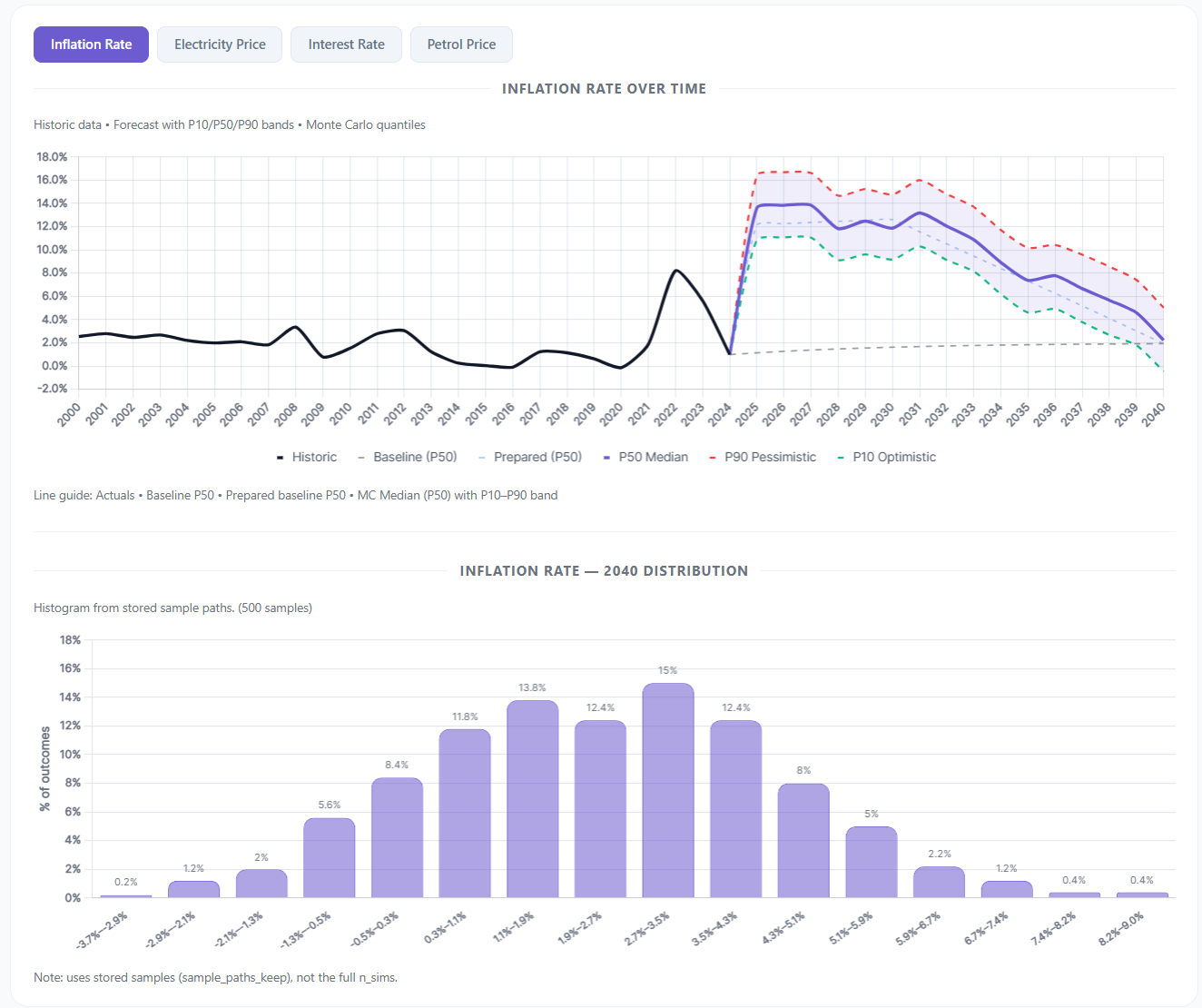
Each simulation path is a complete 25-year time series (2025-2050) with annual values for all 26 KPIs. The fan chart shows P10/P50/P90 quantile envelopes, but the underlying raw paths are individual sequences. For LSTM, Transformer, and other sequential ML architectures, this is native training format: thousands of structurally coherent multivariate time series per country, each following different but causally consistent trajectories.
Cross-Country Diversity: Train on the Full Spectrum
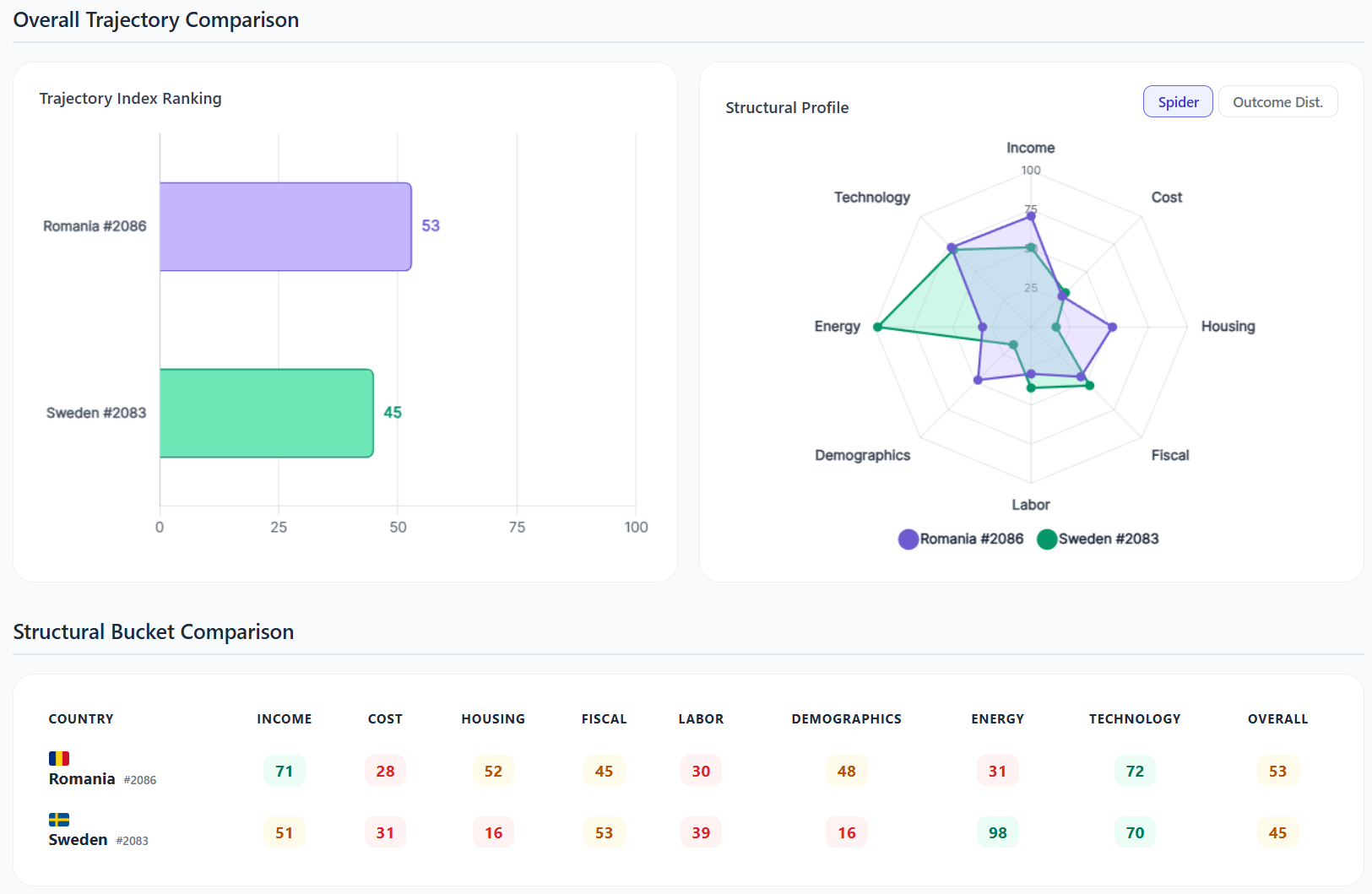
The same 26 KPIs produce fundamentally different structural profiles across countries. Romania (TI 0.53) and Sweden (TI 0.45) show opposite patterns: Romania leads on Income, Housing, and Demographics; Sweden leads on Fiscal and Energy. Training on a single country's data produces models that overfit to one structural pattern. WorldSim gives you 195 structurally distinct environments with the same schema, maximising training diversity without sacrificing consistency.
Parameterised Scenarios: Controllable Data Generation
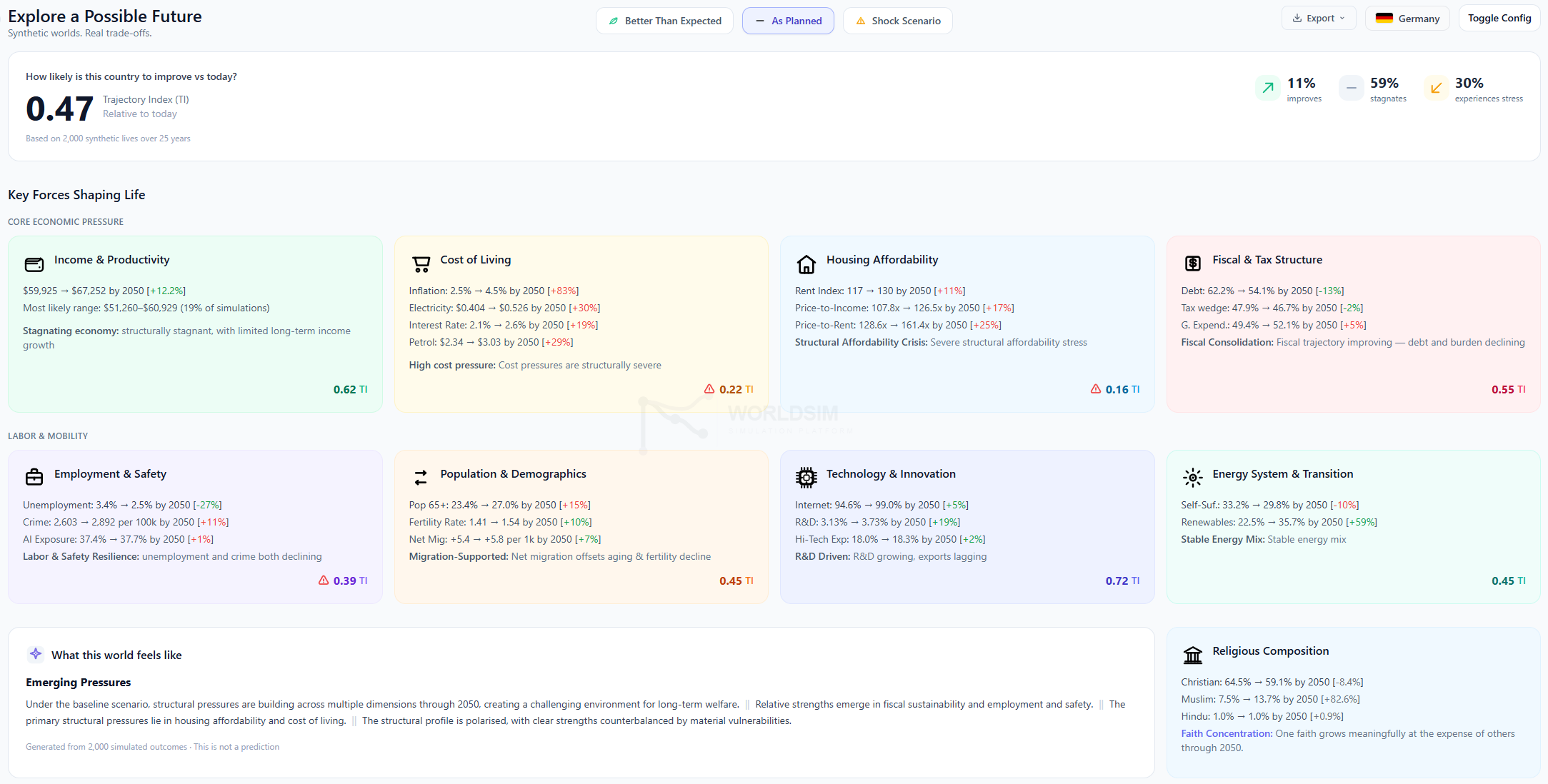
Every dataset is controlled by a scenario configuration: country, path (Better/Average/Shock), KPI tilts (sigma shifts with persistence and decay), and simulation count. Via API, your system can programmatically generate specific macro environments: "Give me 5,000 paths for Germany where inflation is +3σ and unemployment is +2σ for 5 years." This enables iterative learning: your model can request increasingly extreme scenarios, test its own boundaries, and even integrate WorldSim's engine as a structured environment for reinforcement learning or agent-based exploration.
Key Takeaway for AI & Data Teams
Historical macro data is scarce: ~25 years of clean data per country, with 2-3 recession episodes. You can't train a robust model on 3 recessions. WorldSim generates thousands of structurally coherent recession, recovery, crisis, and boom scenarios across 195 countries, each respecting the causal macro relationships that your model needs to learn. The coupling rules provide structured causal narratives that LLMs can consume as context. The raw paths provide multivariate time series that sequential models can train on. The parameterised API enables your system to generate its own training environments on demand. This is the synthetic macro data infrastructure that the $2.7B synthetic data market has been missing.