Methodology

How WorldSim Works

WORLDSIM is a probabilistic socio-economic world simulation platform for long-horizon scenario exploration through controllable, reproducible synthetic environments.

It generates full probability distributions of plausible futures across 26 indicators, 9 domains, and 195 countries, enabling institutions to stress-test decisions and explore structural trade-offs across thousands of simulated trajectories.

Platform Architecture

End-to-End Simulation Pipeline

From canonical data ingestion through to personal-level outcome generation, six sequential layers produce structurally coherent probabilistic futures.

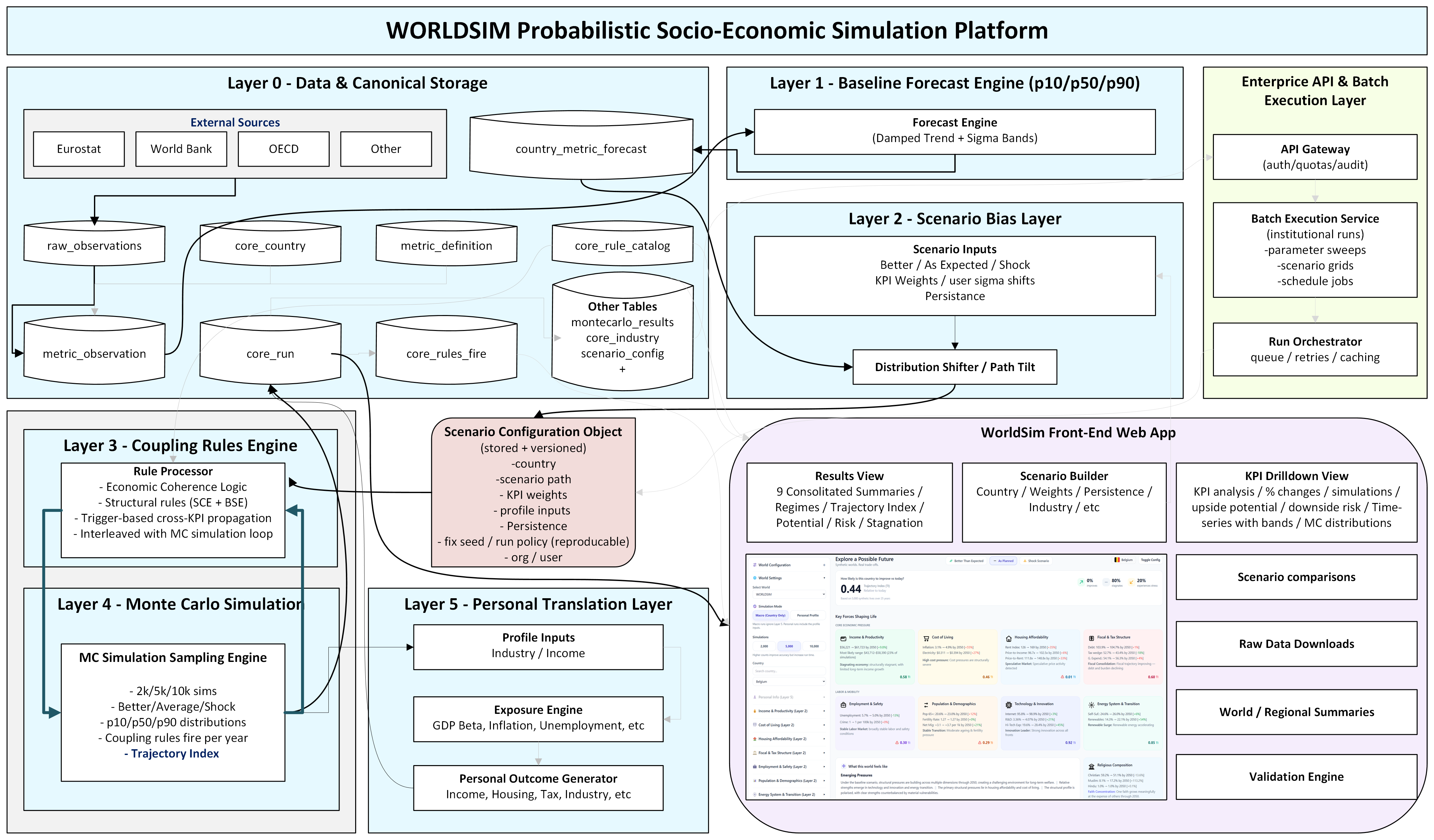
WorldSim Platform Architecture
WorldSim 6-Layer Platform Architecture Diagram

Click to enlarge. L0: Canonical Data → L1: Baseline Engine → L2: Scenario Bias → L3: Monte Carlo → L4: Coupling Rules → L5: Personal Translation.

Simulation Engine

The 6-Layer Architecture

Each simulation pass applies six sequential layers. Every layer modifies the output of the previous one, building structural complexity incrementally.

LAYER 0

Data & Canonical Storage

Macroeconomic indicators ingested from World Bank, OECD, Eurostat, and IMF. All data is harmonised into a canonical database ensuring cross-country comparability and full reproducibility. Covers 195 countries with historical observations from 2000 to present.

LAYER 1

Baseline Forecast Engine

Damped-trend probabilistic forecasting producing P10/P50/P90 trajectories per KPI to 2050. Sigma-band width reflects historical volatility per indicator and per country, capturing structural uncertainty from the outset.

LAYER 2

Scenario Bias Layer

Users apply directional sigma-shift tilts, for example +1.5σ on net migration or −1σ on government debt, with configurable persistence and decay parameters. Three scenario paths: Better Than Expected, As Planned, and Shock. The bias shifts all three distribution bands simultaneously, preserving stochastic dynamics.

LAYER 3

Monte Carlo Simulation

Each scenario runs 2,000 to 10,000 stochastic trajectories using two-piece lognormal and bounded-logit draws. The engine generates statistically stable probability distributions per KPI, classified into three outcome regimes: Improvement, Stagnation, and Structural Stress.

LAYER 4

Coupling Rules Engine

100+ structural rules fire sequentially within each simulation loop. System Coupling Engine (SCE) rules model structural macroeconomic interactions. Black Swan Engine (BSE) rules model tail-risk events. All rules include explicit trigger conditions, floor/ceiling guards, and asymmetric effects.

LAYER 5

Personal Translation Layer

Macro trajectories are mapped to household-level exposure outcomes using age, industry, and income profile inputs, translating macroeconomic uncertainty into interpretable personal projections of income, housing affordability, and employment stability.

Simulation Engine

Monte Carlo Simulation

WorldSim generates thousands of stochastic trajectories per scenario, producing statistically stable probability distributions for every KPI across the full simulation horizon.

Stochastic Trajectory Generation

Each scenario generates 2,000 to 10,000 independent simulation paths using two-piece lognormal distributions for unbounded indicators and bounded-logit draws for rate-constrained variables. This produces full distributional coverage across every KPI for every year to 2050.

Quantile Outputs (P10 / P50 / P90)

Results are stored as quantile fan charts: P10 (optimistic bound), P50 (median trajectory), and P90 (pessimistic bound). Sigma conversion maps user-defined bias tilts to distributional shifts across all three bands simultaneously, preserving the stochastic structure.

Outcome Regimes & Trajectory Index

Simulation outcomes are classified into three structural regimes: Improvement, Stagnation, and Structural Stress. These are based on per-KPI score distributions. The Trajectory Index aggregates these into a single country-level forward-looking structural outlook score.

Reproducibility

Every simulation is deterministic per run group and fixed seed. The same configuration will always produce the same trajectories, enabling institutional audit trails and regulatory compliance.

Simulation Parameters

2,000 – 10,000
Stochastic trajectories per scenario run
26
Structural KPIs simulated per country
2025 – 2050
Forward simulation horizon
3
Scenario paths per run (Better / Average / Shock)
195
Countries and territories covered
Structural Logic

Coupling Rules Engine

Over 100 structural rules enforce causal economic coherence within each simulation loop, ensuring that macro variables interact realistically across domains.

System Coupling Engine (SCE)

SCE rules model structural macroeconomic interactions: the relationships between variables that hold across economic cycles. Examples include inflation driving housing affordability deterioration, ageing population creating fiscal pressure, and GDP growth propagating to labour market improvement.

Black Swan Engine (BSE)

BSE rules model tail-risk events: low-probability, high-impact structural disruptions including recession regimes, financial crisis dynamics, and systemic shocks. These rules activate only when specific extreme conditions are met, introducing asymmetric downside dynamics.

Exclusive Groups

Related rules are organised into exclusive groups to prevent conflicting effects from firing simultaneously. For example, interest rate regime rules are mutually exclusive; only one rate-driven effect applies per simulation year.

How Rules Propagate

Rules fire sequentially year-by-year within each simulation path. A single structural shift can cascade across multiple domains:

1
GDP declines > 3%
Recession trigger
2
Unemployment rises
Labour stress
3
Migration declines
Emigration pressure
4
Debt rises, revenue falls
Fiscal pressure

Each rule defines an explicit trigger condition, a target KPI, a directional effect, and floor/ceiling guards that prevent unrealistic extremes.

Coverage

26 KPIs Across 9 Domains

WorldSim models the full structural landscape of a country, from macroeconomic fundamentals to demographics, energy, and technology.

Domain Indicators
Income & Productivity GDP per capita
Cost of Living Inflation rate, Electricity price (household), Policy interest rate, Petrol price
Housing Affordability Rent index, Price-to-income ratio, Price-to-rent ratio
Fiscal & Tax Structure Tax wedge (average worker), Government expenditure (% GDP), Government revenue (% GDP), Public debt (% GDP)
Labour Market Unemployment rate, Crime rate (per 100k), AI displacement exposure
Demographics Population share 65+, Total fertility rate, Net migration rate (per 1,000)
Social & Cultural Religion shares (Christian, Muslim, Hindu, Other/Atheist)
Energy Energy self-sufficiency, Renewable energy share
Technology Internet users (%), R&D expenditure (% GDP), High-tech exports (%)

What Each Indicator Measures

Every KPI in WorldSim captures a distinct structural dimension. The Description column explains what the variable is and how it is defined. The Impact column explains how it interacts with the simulation engine.

Indicator Description Impact on WorldSim
GDP per capita A country's total economic output divided by its population, measured in current USD. The most widely used single measure of average living standards and economic development. The highest-weighted KPI in the Trajectory Index (Tier 1). A sustained decline triggers recession-regime BSE rules that cascade to unemployment, migration, and fiscal pressure across the entire simulation.
Inflation rate The annual percentage change in consumer prices (CPI). Measures how fast the cost of a standard basket of goods and services is rising or falling for households. Propagates to housing affordability, cost-of-living pressure, and real wage erosion through SCE coupling rules. Persistent high inflation triggers the "Persistent" cost-of-living regime.
Electricity price The price households pay per kilowatt-hour of electricity, expressed in USD. Varies by country based on energy mix, subsidies, grid infrastructure, and regulation. Feeds into cost-of-living regime classification and is linked to energy self-sufficiency through coupling rules. Energy price shocks trigger the "Energy-driven" cost-of-living regime.
Policy interest rate The benchmark rate set by a country's central bank (e.g. ECB, Fed). Determines the cost of borrowing across the economy and is the primary tool for monetary policy transmission. Drives housing affordability through mortgage cost transmission and affects sovereign debt sustainability. Exclusive interest rate regime rules ensure only one rate-driven effect fires per year.
Petrol price The retail price of petrol per litre in USD. Reflects global crude oil markets, domestic fuel taxes, and subsidies. A direct daily cost affecting household transport budgets. A direct cost-of-living pressure indicator. Sustained high petrol prices trigger the "Fuel-driven" regime classification and propagate to transport-dependent economic sectors.
Rent index The OECD Rent Price Index, normalised so that each country's own 2015 rental level = 100. A value of 115 means rents have risen 15% since 2015 in that country. This is a time-series index measuring rental inflation over time, not a cross-country price comparison. Part of the housing affordability triad (with price-to-income and price-to-rent). Together they determine the housing regime: speculative, rent-led, affordable, or structural crisis.
Price-to-income ratio The ratio of median property prices to median annual household income. Measures how many years of income it takes to buy a home, a fundamental gauge of housing accessibility for buyers. High ratios signal structural housing stress. Triggers speculative or buyer's market regime rules and interacts with interest rate coupling to model mortgage affordability dynamics.
Price-to-rent ratio The ratio of property purchase prices to annual rental income. A high ratio suggests property is overvalued relative to its rental yield, indicating speculative demand rather than use-value demand. Distinguishes between speculative asset appreciation and rental-market-driven dynamics. Used alongside price-to-income and rent index in housing regime classification.
Tax wedge The difference between what an employer pays for a worker and what the worker takes home, expressed as a percentage. Includes income tax, employee and employer social security contributions. Affects labour competitiveness and net take-home pay. High tax wedges trigger the "Tax-Led" fiscal regime and interact with GDP growth rules to model labour market drag.
Gov. expenditure (% GDP) Total government spending, including public services, social transfers, defence, and debt interest, as a share of GDP. Measures the size of the state in the economy. Combined with revenue and debt, determines the fiscal regime: consolidation, stability, stress, or debt accumulation. Expenditure shocks propagate to debt dynamics.
Gov. revenue (% GDP) Total government income from taxes, fees, and other sources as a share of GDP. Reflects the state's capacity to fund public services and service debt obligations. Revenue shortfalls relative to expenditure trigger fiscal stress coupling rules. The gap between revenue and expenditure drives debt accumulation dynamics in the simulation.
Public debt (% GDP) Total outstanding government debt as a share of GDP. The standard measure of sovereign indebtedness used by institutions like the IMF and credit rating agencies. A no-reversion KPI; debt is path-dependent and does not mean-revert in the engine. High debt activates fiscal pressure rules that constrain expenditure and propagate to other domains.
Unemployment rate The percentage of the labour force that is actively seeking work but unable to find employment. Calculated using ILO methodology as a standardised cross-country measure. A Tier 2 KPI in the Trajectory Index. Unemployment shocks cascade to migration outflows, crime rates, and fiscal pressure (lower tax revenue, higher social spending) through coupling rules.
Crime rate (per 100k) The number of reported criminal offences per 100,000 residents per year. An aggregate measure of public safety that reflects both actual crime and institutional reporting capacity. Captures social deterioration linked to economic stress. Responds to unemployment and GDP shocks through coupling rules and contributes to the Labour Market domain regime score.
AI displacement exposure The estimated share of a country's workforce employed in occupations with high exposure to AI-driven automation, based on industry-level AI susceptibility scores across 40 sectors. A forward-looking structural risk indicator. Triggers "AI Transition" and "AI-Amplified" labour regimes. Connected to the Personal Translation Layer for individual job risk projections.
Population share 65+ The percentage of the total population aged 65 and over. The primary indicator of demographic ageing, driven by declining fertility, rising life expectancy, and migration patterns. A no-reversion KPI; ageing is structurally irreversible. Drives fiscal pressure (pensions, healthcare), labour supply constraints, and triggers "Demographic Winter" regime when combined with low fertility.
Total fertility rate The average number of children born per woman over her lifetime, based on current age-specific birth rates. A rate of 2.1 is considered the replacement level for stable population size. A no-reversion KPI that determines long-term demographic trajectory. Below-replacement fertility compounds ageing dynamics and triggers "Demographic Decline" regime classification.
Net migration rate The difference between immigration and emigration per 1,000 population per year. Positive values mean more people entering than leaving; negative values indicate net population outflow. Responds dynamically to economic conditions: GDP decline and unemployment drive emigration; growth attracts immigration. Triggers "Migration-Supported" or demographic decline regimes.
Religion shares (4) The percentage of the population identifying as Christian, Muslim, Hindu, or Other/Atheist. Based on census and survey data. Other/Atheist is derived as 100 minus the other three shares. No-reversion KPIs that model long-term cultural and demographic composition shifts. These evolve slowly and are not subject to mean-reversion in the engine.
Energy self-sufficiency Domestic energy production as a percentage of total energy consumption. A value of 100% means a country produces all the energy it consumes; below 100% indicates import dependency. Low self-sufficiency triggers energy vulnerability and dependency regime rules. Propagates to electricity prices, cost of living, and overall economic resilience in the simulation.
Renewable energy share The percentage of total energy supply generated from renewable sources (solar, wind, hydro, biomass, geothermal). Measures progress in the transition away from fossil fuels. Higher renewable share improves energy security scores and triggers "Green Transition" or "Renewable Surge" regime classification. Interacts with self-sufficiency through coupling rules.
Internet users (%) The percentage of the population who have used the internet in the past 12 months. A basic measure of digital connectivity and infrastructure access across a population. Contributes to the Technology domain score. Combined with R&D spending and high-tech exports, determines whether a country is classified as an innovation leader or in digital deficit.
R&D expenditure (% GDP) Total national spending on research and development, by government, business, and academia, as a share of GDP. The standard measure of a country's investment in innovation capacity. Drives the "R&D Driven" and "Innovation Leader" technology regimes. Higher R&D spending signals long-term productivity potential and strengthens the Technology domain score.
High-tech exports (%) High-technology products (aerospace, computers, pharma, scientific instruments) as a percentage of total manufactured exports. Measures a country's position in global technology value chains. Captures innovation output capacity. A high share supports the "Innovation Leader" regime. A declining share contributes to "Technology Stagnation" or "Deficit" classification.
Data Foundation

Data Sources & Coverage

WorldSim's canonical database harmonises macroeconomic data from the world's most authoritative institutional sources.

World Bank

World Bank

World Development Indicators: GDP, demographics, labour market, infrastructure, and development metrics across all countries.

IMF

International Monetary Fund

World Economic Outlook: fiscal indicators, government expenditure, revenue, public debt, and macroeconomic aggregates.

OECD

OECD

Tax, housing, energy, and labour statistics, including tax wedge calculations, price indices, and energy balances for member economies.

Eurostat

Eurostat

European statistical office, providing high-frequency socio-economic data, energy prices, migration, and demographic structure for EU member states.

195
Countries & territories
2000 – 2025
Historical observation window
2025 – 2050
Forward simulation horizon
Validation

Empirical Validation & Reproducibility

WorldSim includes a purpose-built Validation Engine that runs historical cut-off simulations to verify structural coherence and distributional performance against real-world data.

77 – 89%
Distributional Coverage

Actuals within P10–P90 bands over 9-year horizon

63 – 86%
Directional Accuracy

Correct identification of improvement vs. deterioration

17+
Countries Validated

European economies, 5,000 simulations, 2015 cut-off

Backtesting Methodology

The Validation Engine is configured using pre-2015 data, simulated forward to 2024, and compared against actual outcomes across all KPIs:

Distributional coverage: actuals within P10–P90 bands
Structural accuracy: coupling logic across systems
Directional accuracy: improvement vs. deterioration

Evaluation Period

The 2016–2024 evaluation period covers one of the most structurally challenging periods in recent macroeconomic history: the COVID-19 shock (2020–2021), the Ukraine war and energy crisis (2022), and sustained inflationary pressure (2022–2024). High distributional coverage across this period demonstrates robust structural modelling.

Full Reproducibility

Every WorldSim simulation is fully deterministic. Each run is identified by a unique run group ID and fixed seed. The same configuration always produces identical trajectories, enabling institutional audit trails, regulatory compliance, and peer review.

Explore Structural Futures

Run your own scenario simulations across 195 countries, from baseline projections to full Monte Carlo distributions with structural coupling.